SEP Forecasting Papers and Theses
-
On the prediction of >100 MeV solar energetic particle events using GOES satellite data
BibTex
url=https://ieeexplore.ieee.org/document/8258212
@inproceedings{boubrahimi2017satellite,
title={On the prediction of >100 MeV solar energetic particle events using GOES satellite data},
author={Boubrahimi, Soukaina Filali and Aydin, Berkay and Martens, Petrus and Angryk, Rafal},
booktitle={2017 IEEE International Conference on Big Data (Big Data)},
year={2017}}
Summary
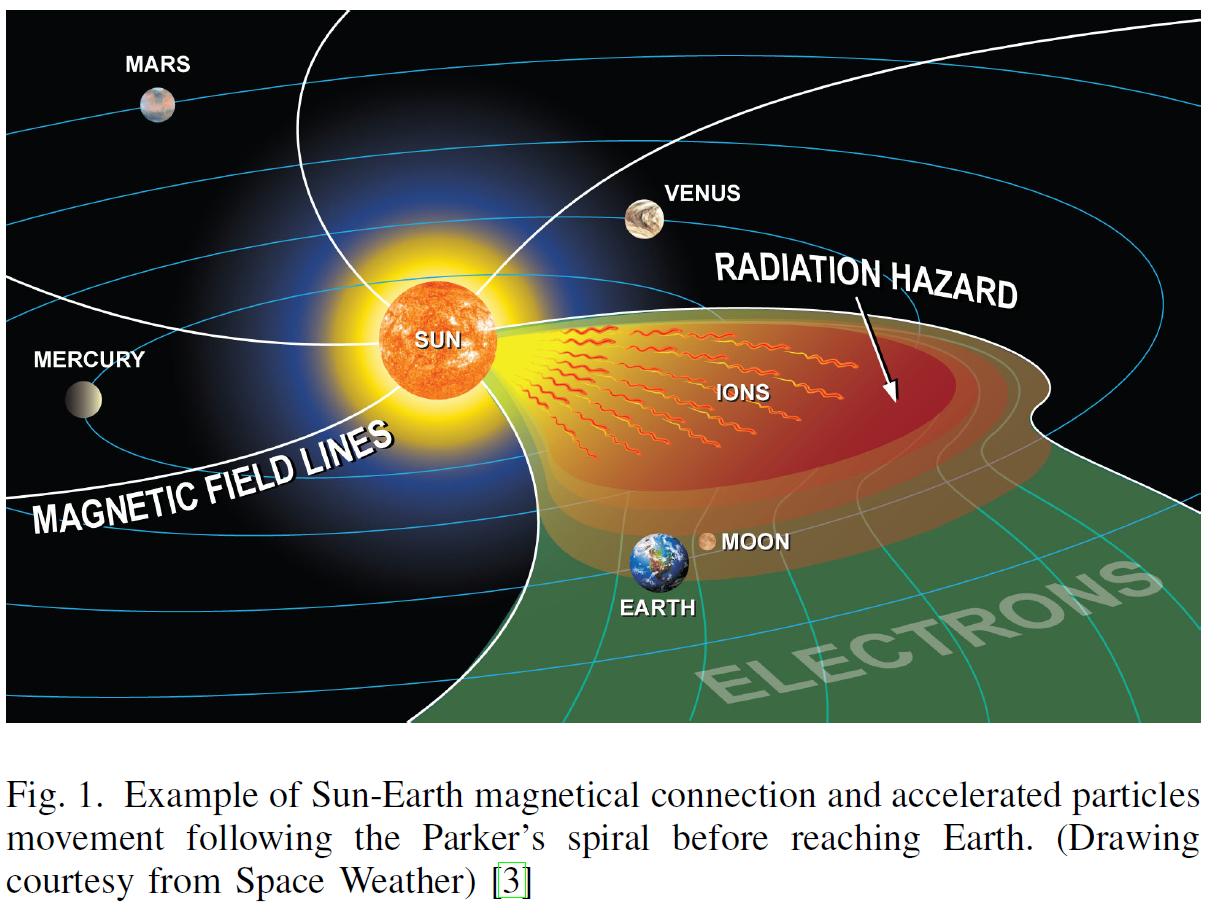
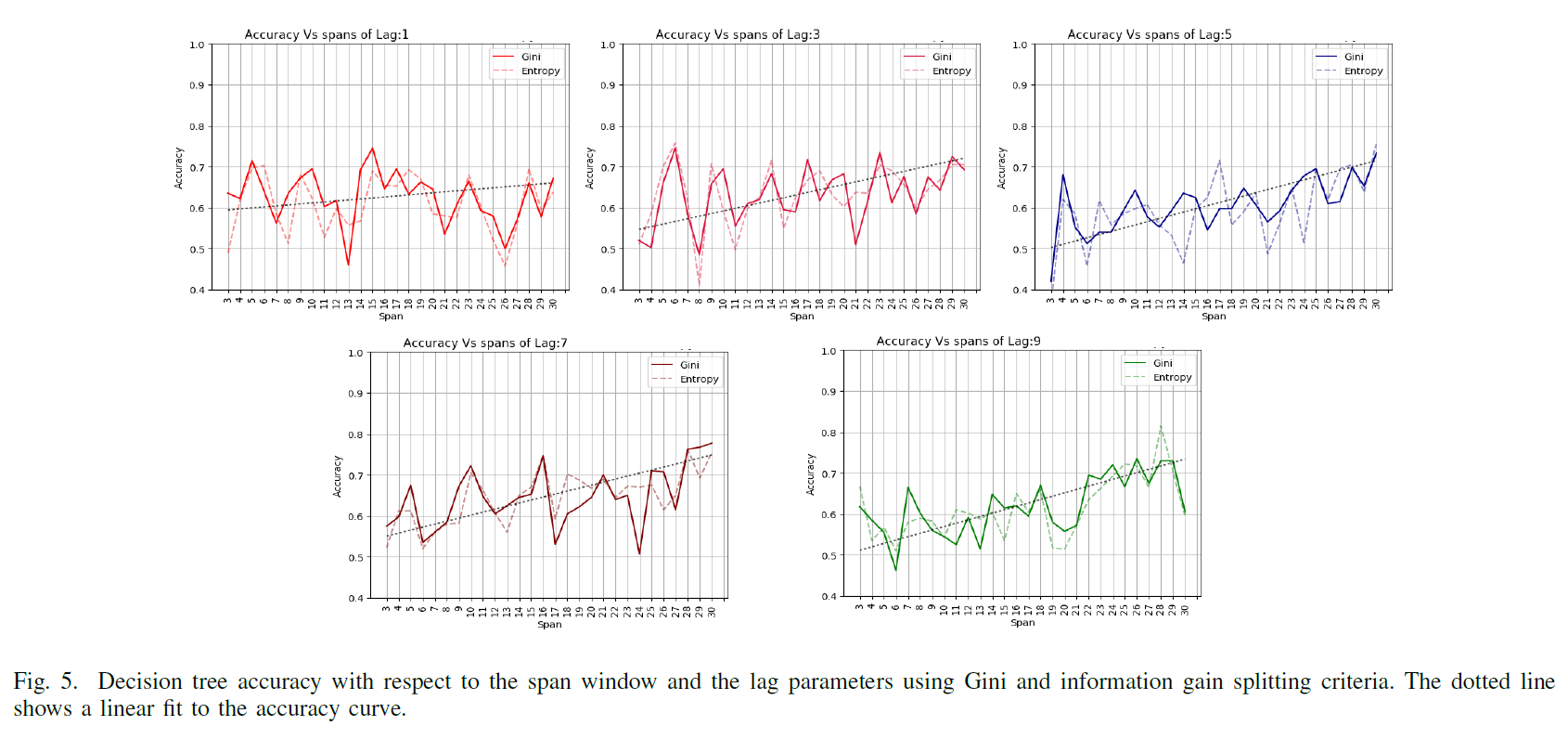
This paper tackles the problem of predicting >100 MeV SEP events from timeseries of proton and x-ray channels with a decision tree. They first start by analyzing X-ray and proton channels as multivariate time series that entail some correlation which may be precusors to the occurence of SEP. They study the correlation across all channels. In total they have 8 channels xs for short wavelength x-ray (.5 -.3 nm) xl for long wavelength x-ray (.1 - .8 nm), and 6 proton channels p6_flux to p11_flux with different energetic interval from 80MeV to >700MeV. To analyze the correlations in channels, they consider the span and the lag in their observation. The span is the number of hours that constitute the observation period prior to an X-ray event. The lag is the factor by which a vlaue of a time series is multipled to produce its previous value in time. To express the X-ray and proton cross-channel correations, they used a vector autoregression model (VAR) where the dependent variables are the proton channels at t and the independent variables are the proton and x-ray channels at time previous times determined by the lag. After fitting the VAR to the data, they use the coefficient as features to a Decision Tree to predict SEP events based on the assumption that the coefficients values would increase as precursors to the event.
Problem Forecasting SEP events with correlation coefficients, X-rays and Protons timeseries
Solution, Ideas and Why proton channels auto-correlation and cross-relation with X-ray is indicative of the occurence of SEPs. Using decision three to predict >100 SEPs from the correlation coefficients
Images
-
Prediction of Solar Energetic Particle Event Peak Proton Intensity Using a Simple Algorithm Based on CME Speed and Direction and Observations of Associated Solar Phenomena
BibTex
url=https://agupubs.onlinelibrary.wiley.com/doi/pdfdirect/10.1029/2018SW002032
@article{richardson2018prediction,
title={Prediction of solar energetic particle event peak proton intensity using a simple algorithm based on CME speed and direction and observations of associated solar phenomena},
author={Richardson, IG and Mays, ML and Thompson, BJ},
journal={Space Weather},
year={2018}}
Summary
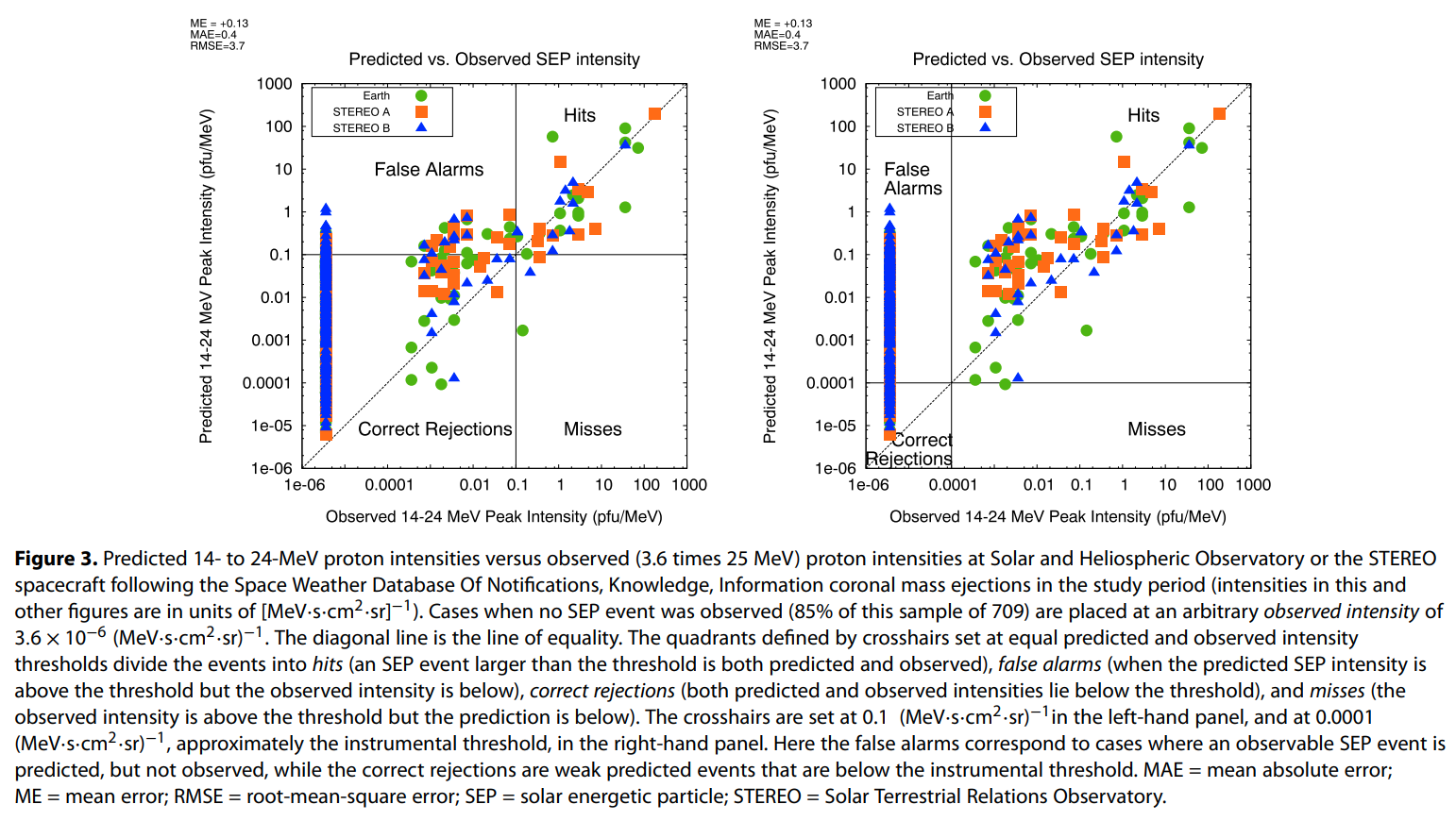
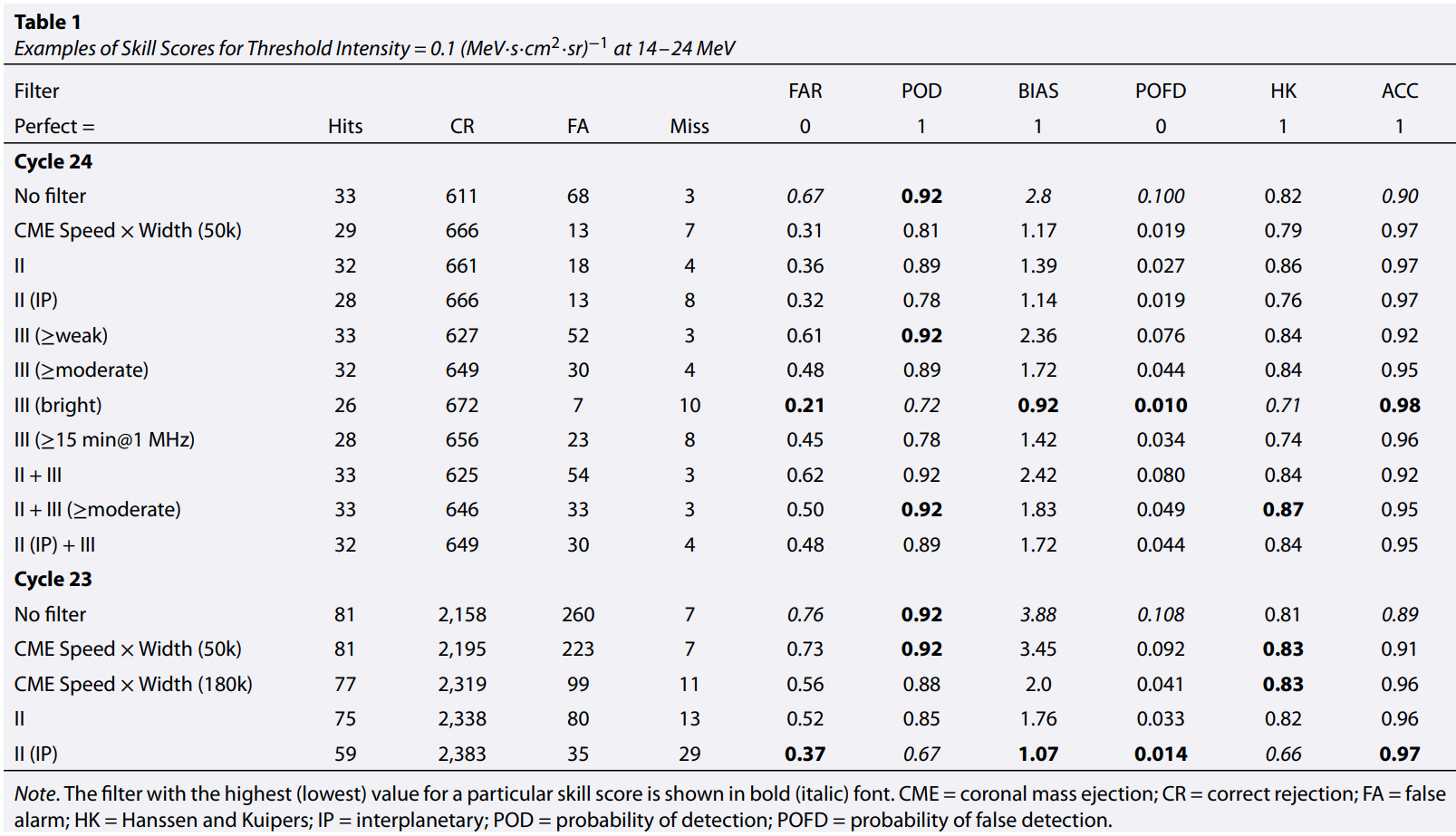
This paper analyses the effectiveness of the Richardson Equation (Richardson et al 2014) for predicting intensity of 14-24MeV protons in SEPs using CME speed and connection angle as features. The richardson equation which is I(𝜙)(MeV s ⋅ cm2 ⋅ sr)−1 ≈ 0.013 exp(0.0036V − 𝜙2∕2𝜎2)), 𝜎 = 43° where the 43° Gaussian width is the average obtained by Richardson et al. (2014). They found that the Richardson equation leads to a lot of false alarms compared in predicting SEPs. By increasing the threshold for the intensity considered SEP, they found that the false alarm rate reduces but so does the number of SEPs they can actually catch. They then explore using the CME speed for filtering out false alarm rate which yields the same reduction in false alarm rate at the cost of missing SEPs as well. They explore using the CME width as well resulting a variant of the same trade off. They explore using interplanetary and non interplanetary type 2 Radio emissions, weak, moderate, and bright Type 3 Radio emissions power and duration as additional filters. They found these filters reduce the false alarm rate but misses weaker SEPs. They conclude that the richardson equation is decent basis for empirical prediction of SEPs.
Problem forecasting CME Speed and Connection angle using the Richardson Equation
Solution, Ideas and Why the richardson equation can be used to predict SEPs only needing CME speed and connection angle. Richardson equation gives a high false positive rate, pairing it with type 2 and 3 emissions or only selecting faster and wider CMEs help reduce false alarm rate, but at the cost of missing some SEPs
Images
-
Forecasting Solar Energetic Particle (SEP) events with Flare X-ray peak ratios
BibTex
url=https://www.swsc-journal.org/articles/swsc/pdf/2018/01/swsc180013.pdf
@article{kahler2018forecasting,
title={Forecasting Solar Energetic Particle (SEP) events with Flare X-ray peak ratios},
author={Kahler, Stephen W and Ling, Alan G},
journal={Journal of Space Weather and Space Climate},
year={2018}}
Summary
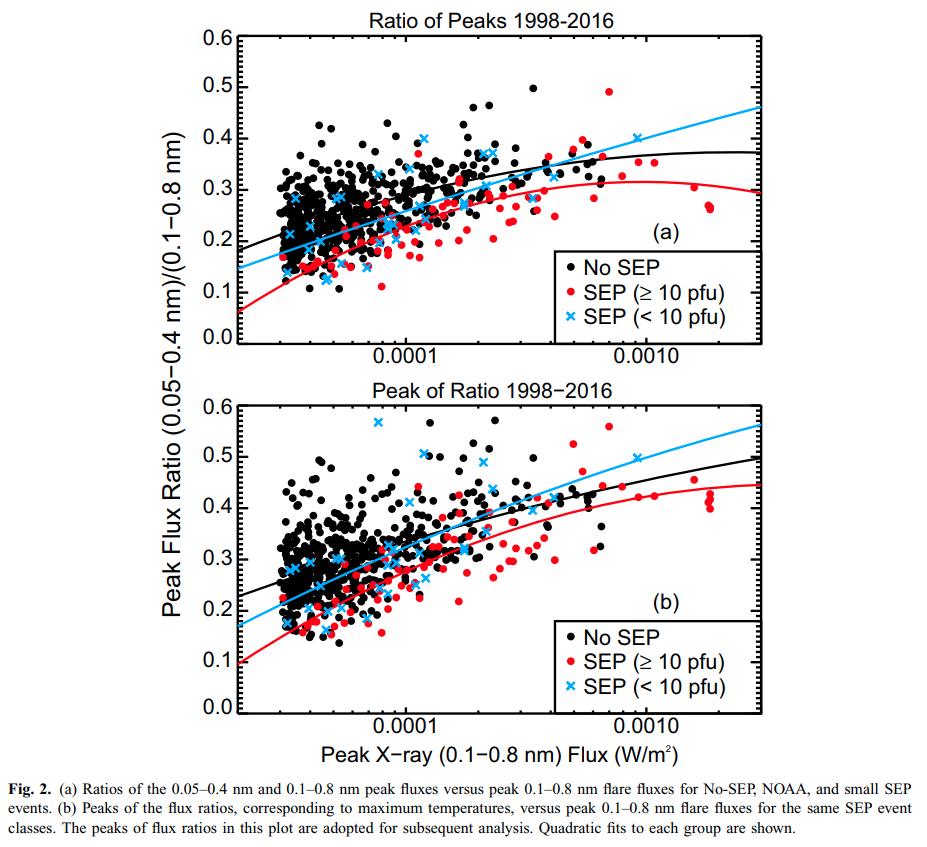
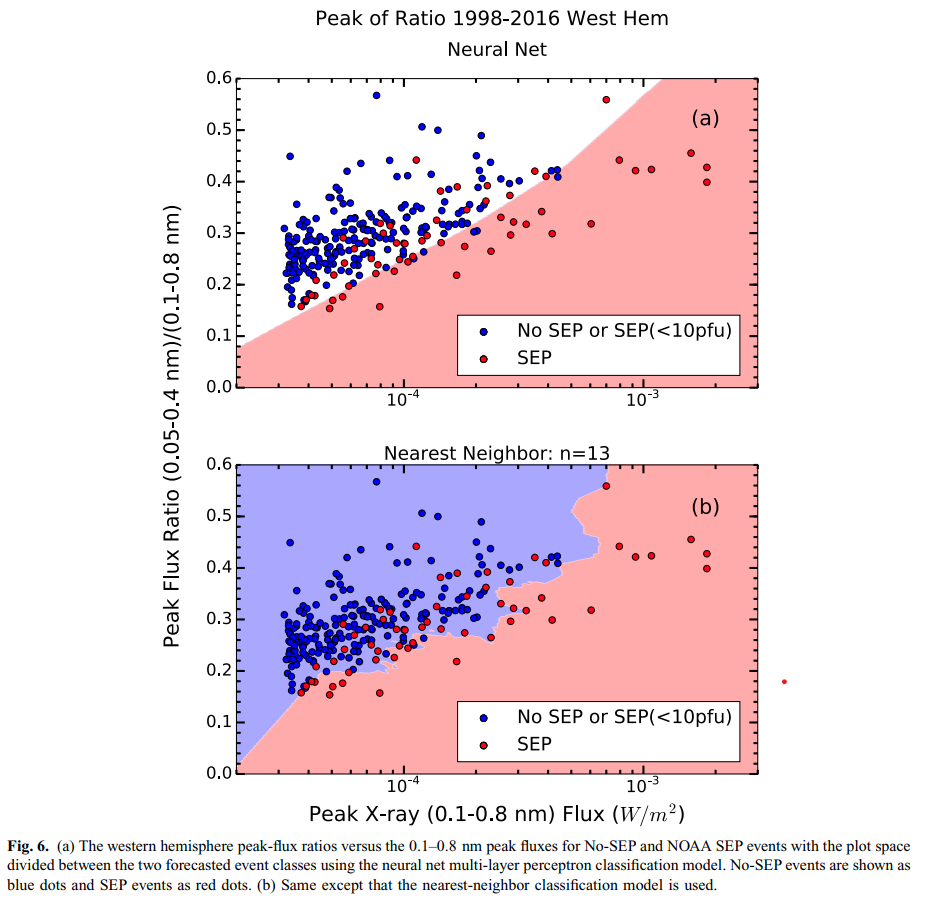
This paper addresses the SEP forecasting with flare X-ray peak ratios. They found that flares associated with >10MeV SEPs of >10 proton flux units have lower peak temperatures than those without SEPs. They first analyze how the ratios of the short (0.05 - 0.4nm) and long (0.1 - 0.8nm) wavelengths x-rays peak fluxes and peak flare fluxes of long wavelengths are useful features for distinguishing SEP events of greater intensity against lower energy and background events. They further analyzed the Eastern and Western hemisphere events and found that the Western hemisphere events are better classified by the peak-flux ratios and peak fluxes. Using the peak flux ratio between the short and long wavelength and the peak fluxes of the long wavelength x-ray as features, they train an MLP and a KNN to classify high-intensity SEPs from low intensity and background events.
Problem Prediction of SEPs Peak Ratio, Peak Flux Ratio of X-rays
Solution, Ideas and Why Compare peak ratios with ratios of peak for short and long wavelength X-rays, eastern and western hemisphere sources. Found ratio of peak and peak of ratios in west hemi as features. use KNN and MLP to predict SEP events using ratio of peaks and the peak flux ratio in the western hemisphere
Images
-
A technique for prediction of SPEs from solar radio flux by statistical analysis, ANN and GA
BibTex
url=https://link.springer.com/article/10.1007/s10509-018-3263-8
@article{kim2018technique,
title={A technique for prediction of SPEs from solar radio flux by statistical analysis, ANN and GA},
author={Kim, Kyong Nam and Sin, Sun Ae and Song, Kum Ae and Kong, Jin Hyok},
journal={Astrophysics and Space Science},
year={2018}}
Summary
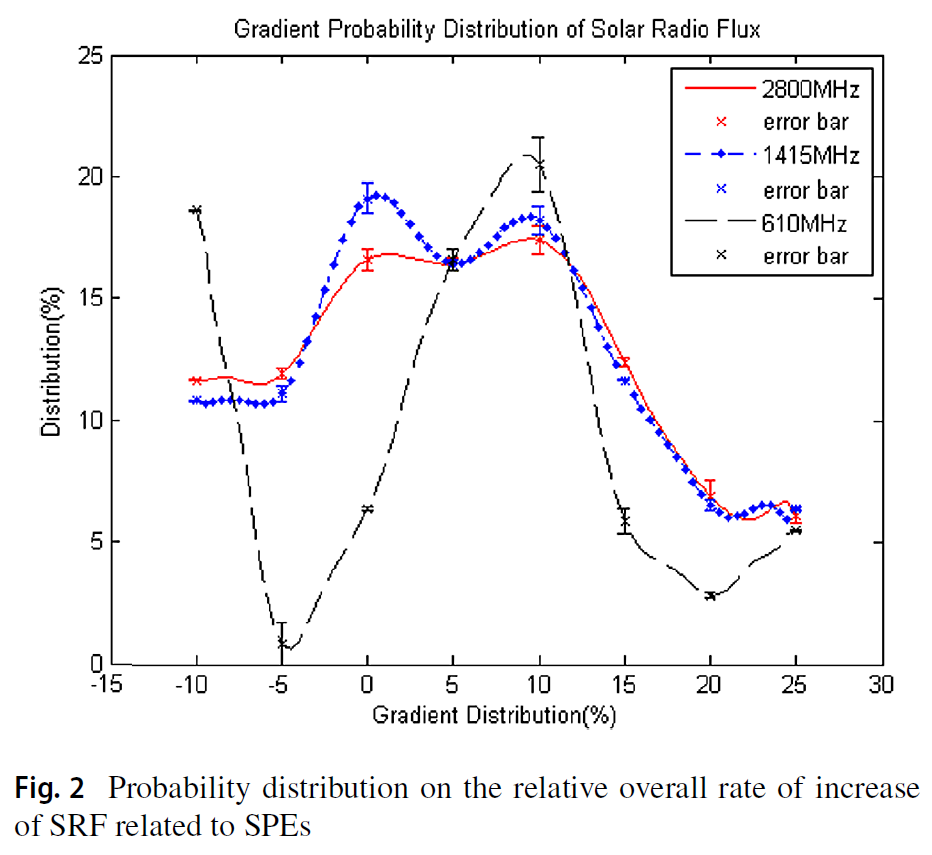
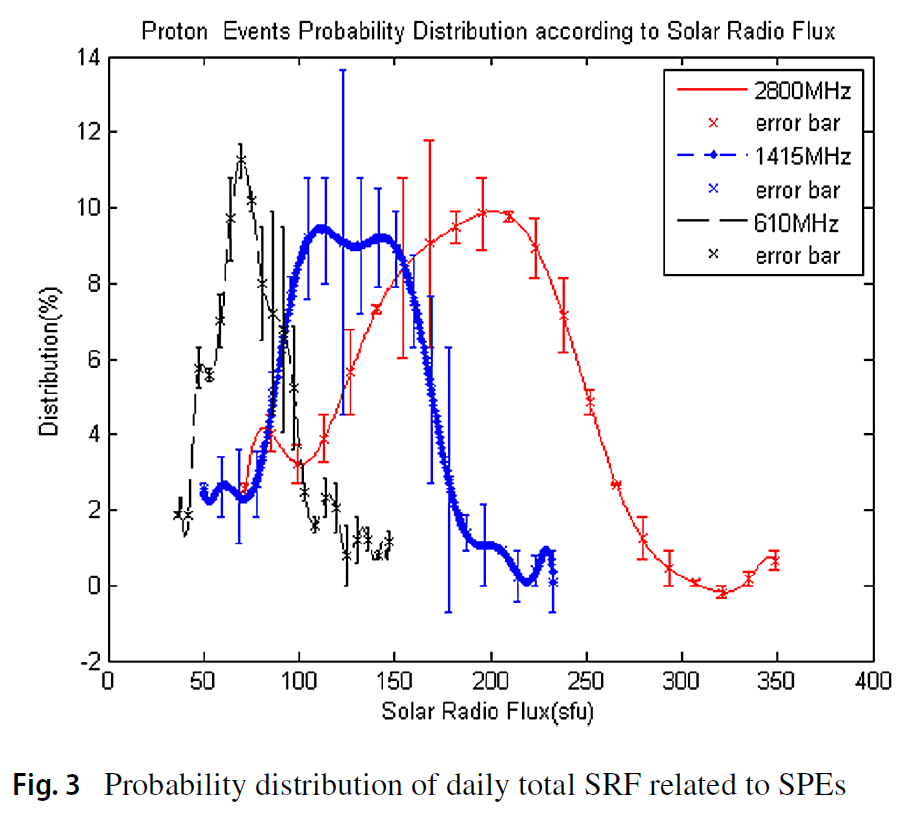
This paper tackles the prediction of SEP events using Solar Radio Flux. By looking at Solar Radio Flux (SRF) at 2800MHz, 1415MHz, and 610MHz, they analyze the solar activity related to those fluxes and the SEPs that might be related. First the analyze the probability distribution on the relative overall rate of increase of SRF related to SEPs and found that a significant increase in the rate of SRF was correlated to an increase in the number of SEPs. They also look at the probability distribution of daily total SRF related to SEPs and found that an increase in the SRF level was correlated to increase in the number of SEPs when only looking at SEPs. Moreoever, the 610MHz band seems to be the earliest and highest correlated precursor to SEP events. Using these findings, they pass all 3 bands SRF rate of increase and the daily total SRF level as features to a Neural Network to predict the number of SEPs. They propose to find the neural network optimal weights using gradient descent or a Genetic Algorithm. Finally the propose a second neural network that is tasked to predict SRF to generate more recent data (within 3 days) if it's not available.
Problem Solar Radio Flux Rate of Increase and Level
Solution, Ideas and Why Investigated the relationship between the rate of increase in SRF , the level of SRF for 2600MHz, 1415MHz, 610MHz, and the number of associated SEPs. 610MHz SRF as features Use a MLP optimized SGD or GA to predict SEP from SRF levels and rate of rate of change
Images
-
Using machine learning methods to forecast if solar flares will be associated with CMEs and SEPs
BibTex
url=https://iopscience.iop.org/article/10.3847/1538-4357/aac81e/pdf
@article{inceoglu2018using,
title={Using machine learning methods to forecast if solar flares will be associated with CMEs and SEPs},
author={Inceoglu, Fadil and Jeppesen, Jacob H and Kongstad, Peter and Marcano, N{\'e}stor J Hern{\'a}ndez and Jacobsen, Rune H and Karoff, Christoffer},
journal={The Astrophysical Journal},
year={2018}}
Summary
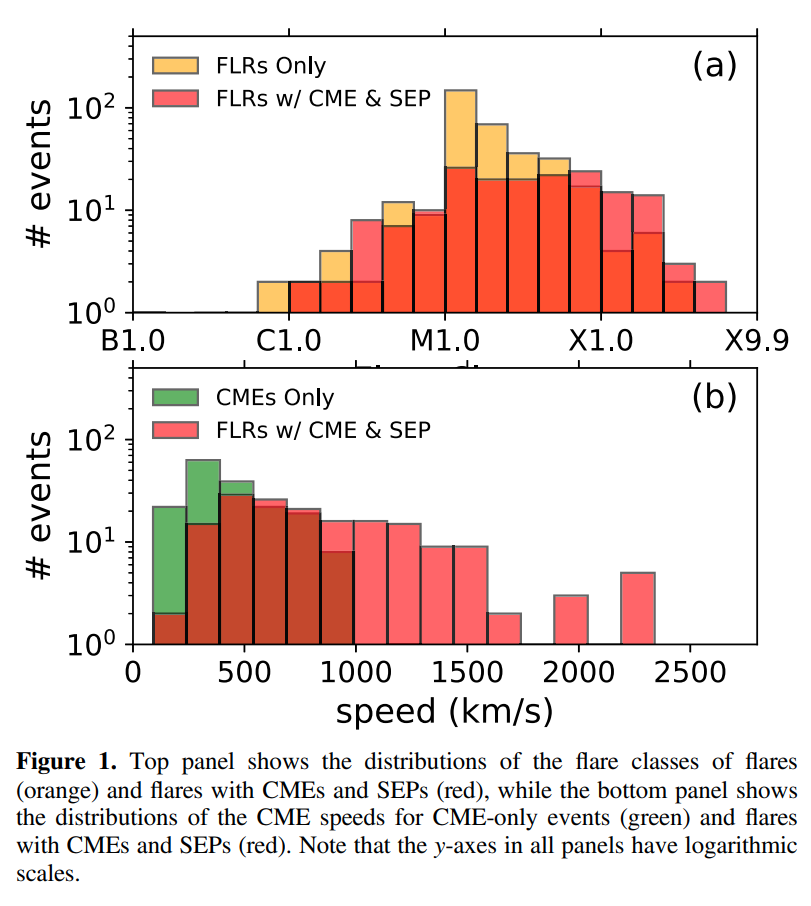
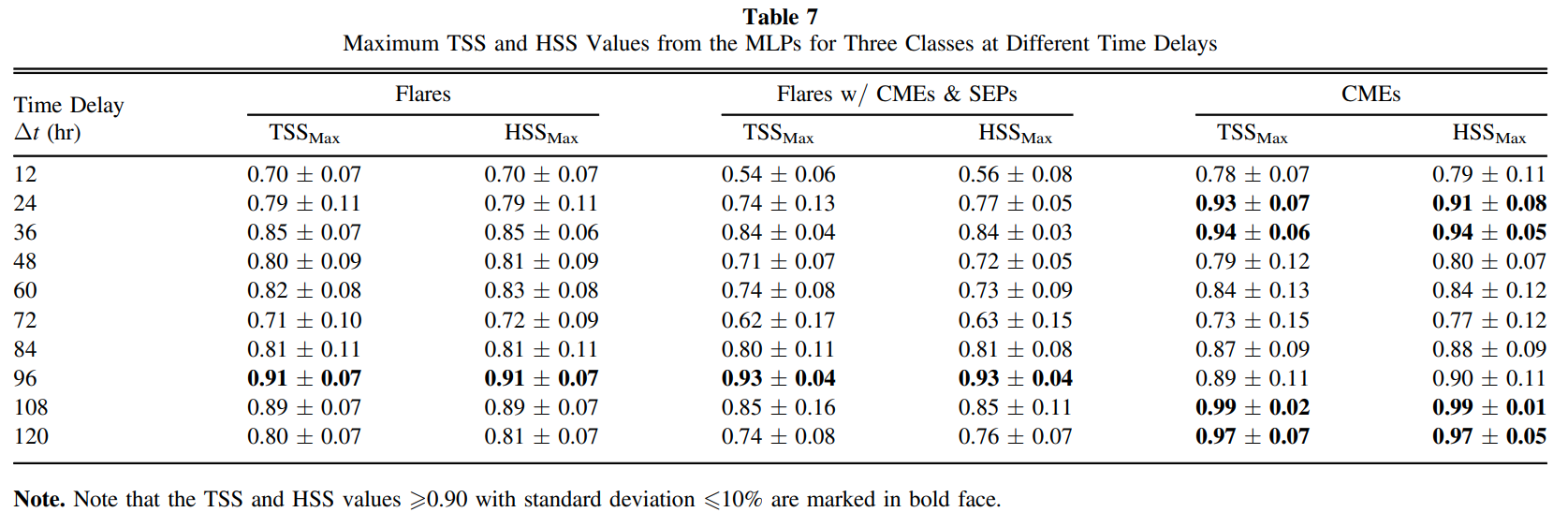
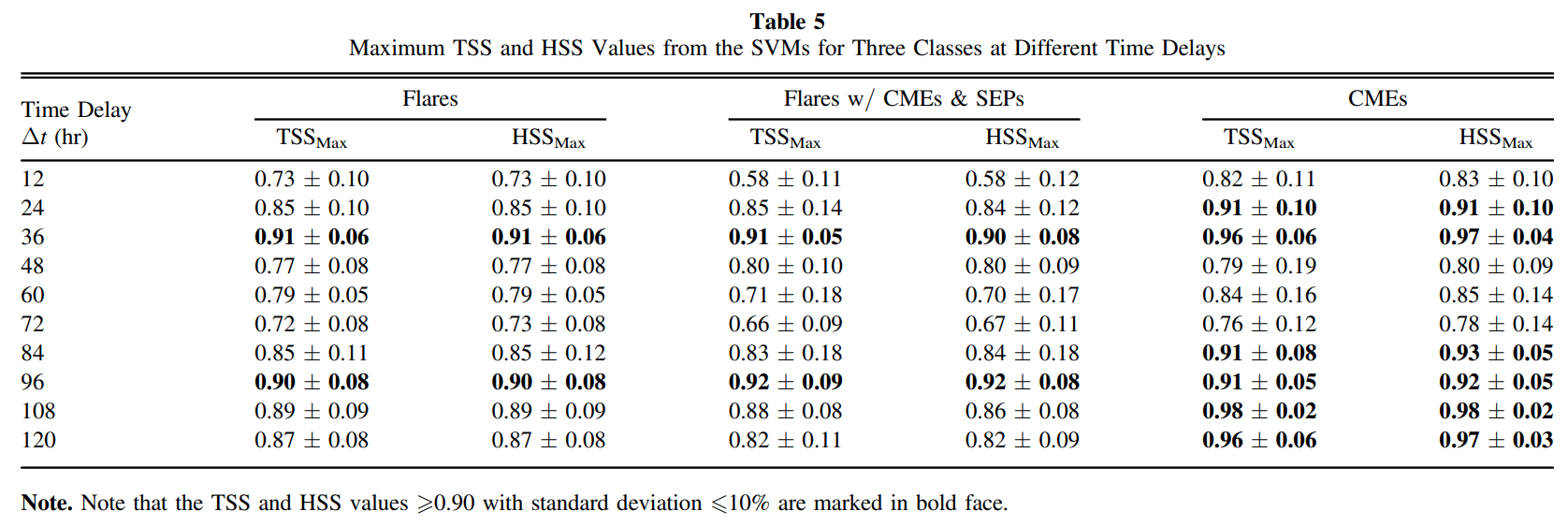
This paper tackles predicting whether Solar Flares will be associated with CME and SEPs. First they start by comparing the number of events associated with Solar Flares alone compared to solar flares with CME and SEPs. They found that Solar Flares associated with CMEs and SEPs tend to have higher classes. They also compared the number of events associated with the speed of CMEs when they are alone and when they are with Solar Flares and SEPs. Again they found that CMEs associated with Solar Flares and SEPs tended to have higher speeds. They also consider Active Regions which are regions of high magnetism. Active regions have been known to generate SEPs. The authors considered features from active regions at some time in the past to predict current SEP events. They employed a SVM and a MLP to ingest those features to output the right class. THey found that the SVM tended to be more accurate than the MLP.
Problem
Solution, Ideas and Why
Images
-
A Machine Learning Approach to Forecasting SEP Events with Solar Activities
BibTex
url=https://cs.fit.edu/~pkc/theses/torres20.pdf
@mastersthesis{Torres2020ml,
author = {Torres, Jesse Scott},
title = {A Machine Learning Approach to Forecasting SEP Events with Solar Activities},
school = {Florida Institute of Technology},
year = {2020},
address = {Melbourne, FL},
month = {December},
}
Summary
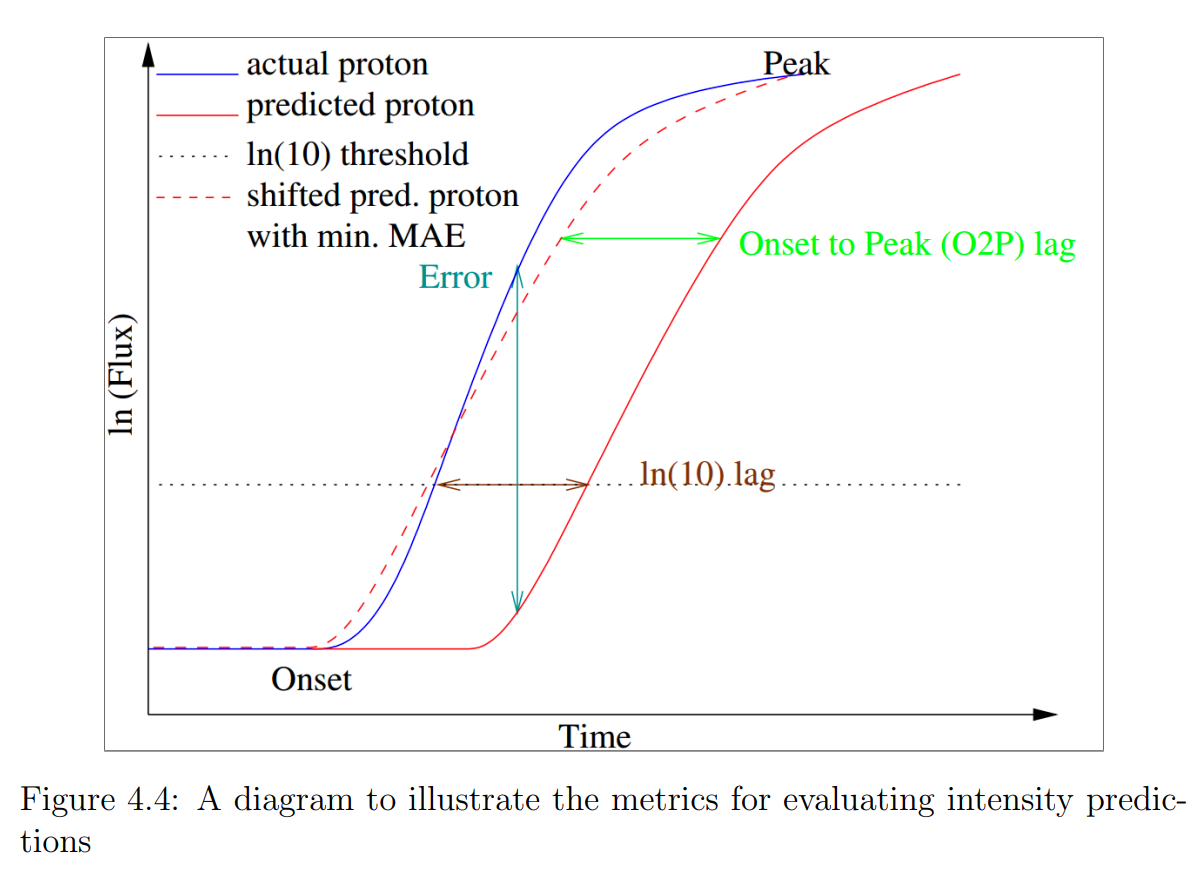
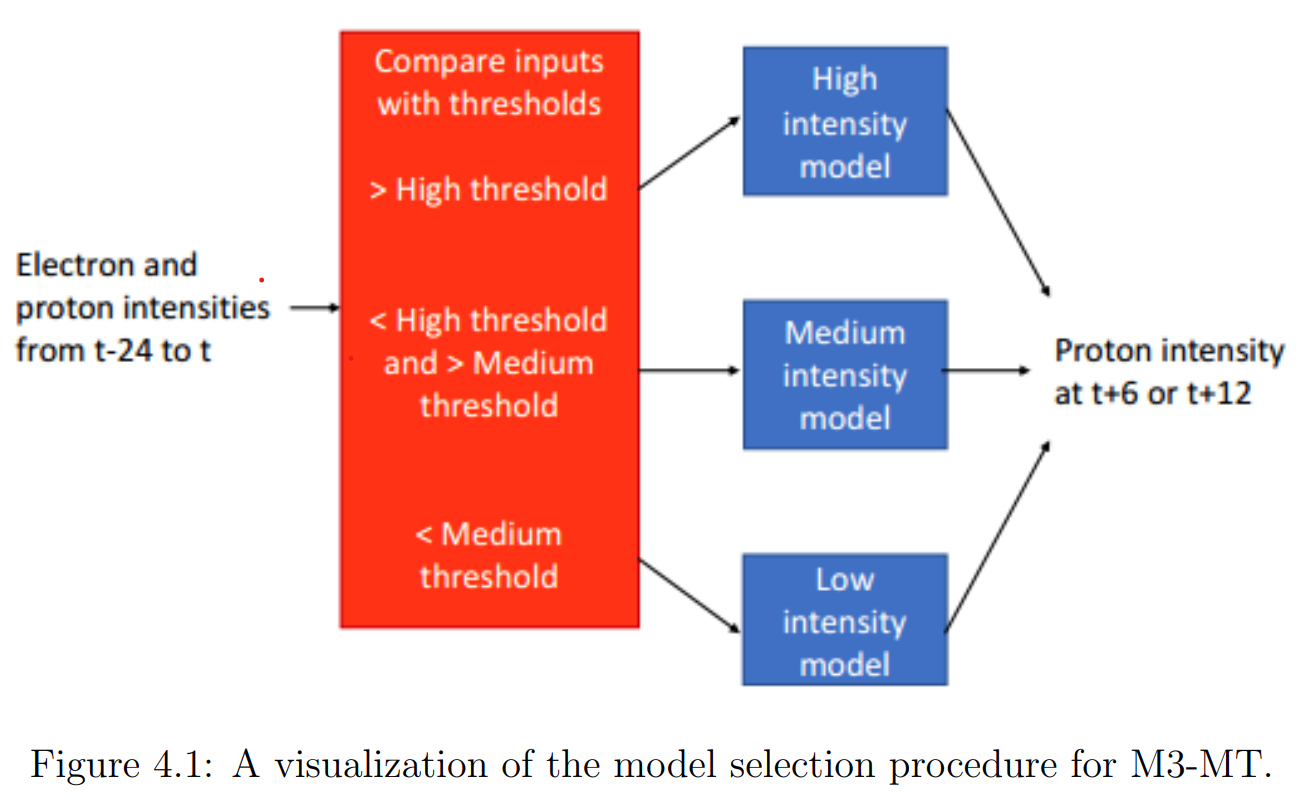
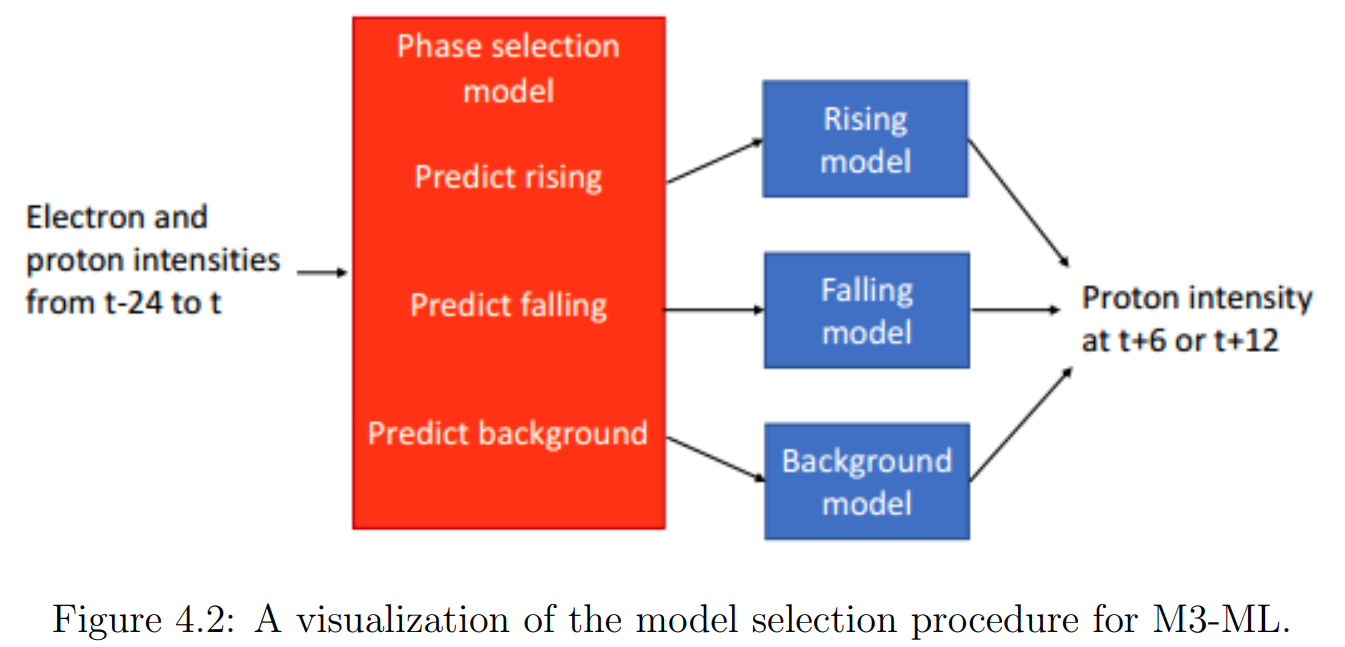
This thesis tackle SEP forecasting based using Proton, Electrons and X-ray timeseries data. Their approach takes as input electron and proton intensities 2hours in the past to output proton intensity in 30mins and an hour in the future. They also add phases information to every 5min timestep as additional input features. The phases are the onset, threshold, peak, and end periods. They applied an MLP and RNN to the forecasting task. They divide their forecasting into 3 levels where a model (MLP or RNN) is dedicated to train and test on that level only. To decide which of the levels is appropriate for each model, they employ either routing algorithm based on predefined thresholds and with the models only focusing on the intensity levels associated with them or use a phase selection model route the timeseries intensities to the different phase models. They add X-rays to the electron data as additional features. To measure the performance of the approaches, they measure Mean Absolute Error between the actual and predicted intensities, the lag between the prediction and the actual intensity forecast between the on-set and peak, the onset and the threshhold, to measure the detection of the rising edge and of the precursory intensity signal respectively. Finally they measure the difference between when the target and and when prediction reaches individually reach ln(10).
Problem Predicting SEPs using Protons, Electrons, and X-ray timeseries data
Solution, Ideas and Why Use CME properties to predict SEP events and Using Time Series data to forecast proton intensity. Used a MLP to predict SEP and an RNN to predict proton intensity by channels . Used MAE, On-Set and On-Peak lag to evaluate intensity
Images
-
Solar energetic particle event occurrence prediction using solar flare soft X-ray measurements and machine learning
BibTex
url=https://www.swsc-journal.org/articles/swsc/pdf/2021/01/swsc210024.pdf
@article{aminalragia2021solar,
title={Solar energetic particle event occurrence prediction using solar flare soft X-ray measurements and machine learning},
author={Aminalragia-Giamini, Sigiava and Raptis, Savvas and Anastasiadis, Anastasios and Tsigkanos, Antonis and Sandberg, Ingmar and Papaioannou, Athanasios and Papadimitriou, Constantinos and Jiggens, Piers and Aran, Angels and Daglis, Ioannis A},
journal={Journal of Space Weather and Space Climate},
year={2021}}
Summary
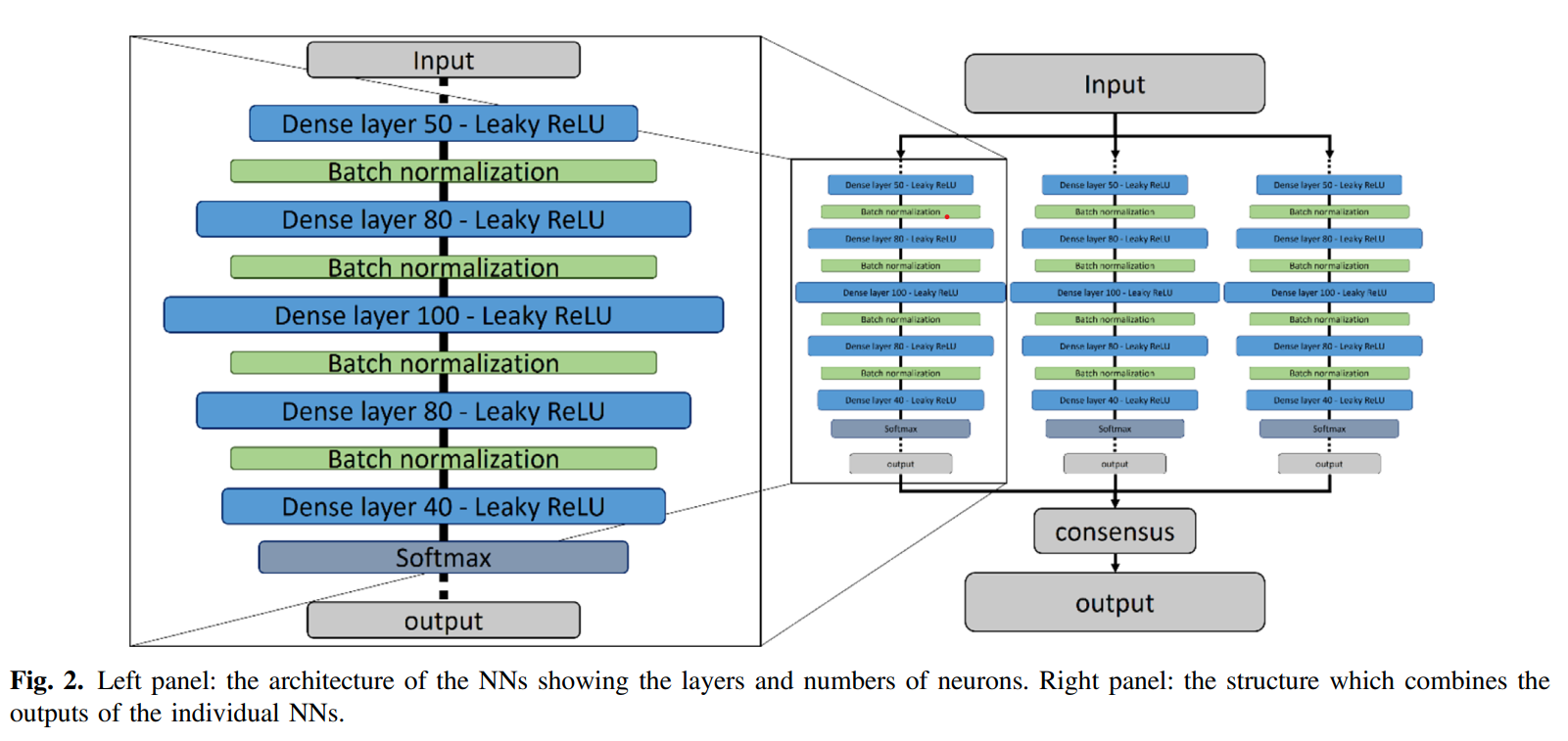
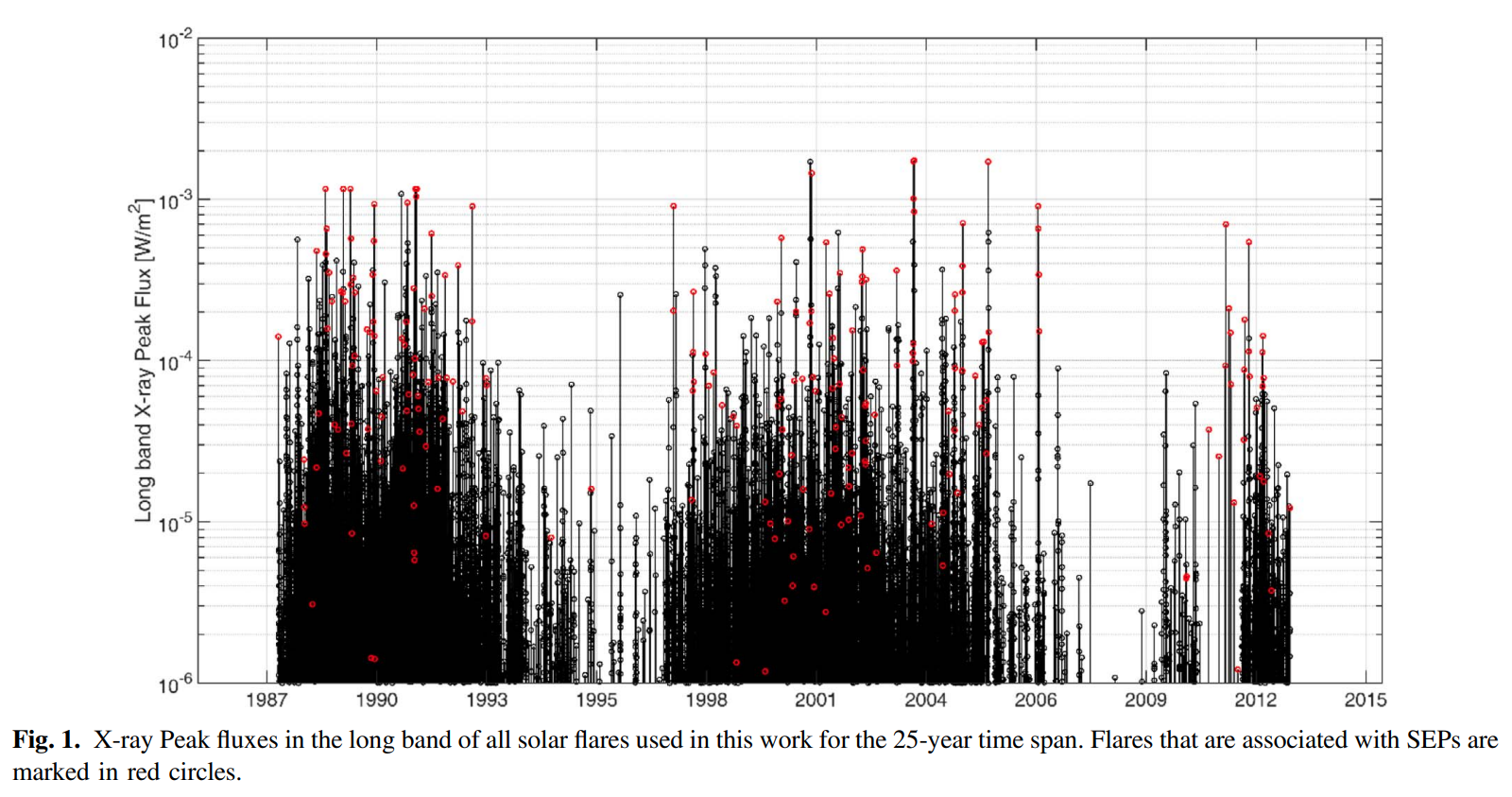
This paper tackles the prediction of SEP events using short and long wavelength X-rays and 24 Solar Flare features such as cosine and sine of the heliolongitude, peak flux and fluence etc. For their classifier, the authors used an ensemble of 3 MLP whose outputs are averaged. They analyze the relationship between X-ray peak fluxes in the long band and the number of SEPs in the dataset to find that More SEPs are related to more intense X-rays. They artificially balance the dataset and found that their method achieve good performance on the balanced dataset. To further analyze the performance of their model, they only focus on type M2 solar flares and found that the uncertainty associated with Solar Flares of M2 ang greater class is larger in their method. They analyze the decision threshold of their method and found it to be best at around .79 for Solar Flares of C1 and above, and .5 for solar Flares of class M2 and above.
Problem prediction of SEPs from X-rays timeseries features
Solution, Ideas and Why Analyze how X-rays and X-rays class >M2 timeseries are correlated with SEP events occurance. used an ensemble of 3 MLP to predict SEP from X-rays with betterresults found for X-rays < M2
Images
-
Assessing the predictability of solar energetic particles with the use of machine learning techniques
BibTex
url=https://link.springer.com/article/10.1007/s11207-021-01837-x
@article{lavasa2021assessing,
title={Assessing the predictability of solar energetic particles with the use of machine learning techniques},
author={Lavasa, E and Giannopoulos, Georgios and Papaioannou, Aikaterini and Anastasiadis, A and Daglis, IA and Aran, Angels and Pacheco, David and Sanahuja, B},
journal={Solar Physics},
year={2021}},
Summary
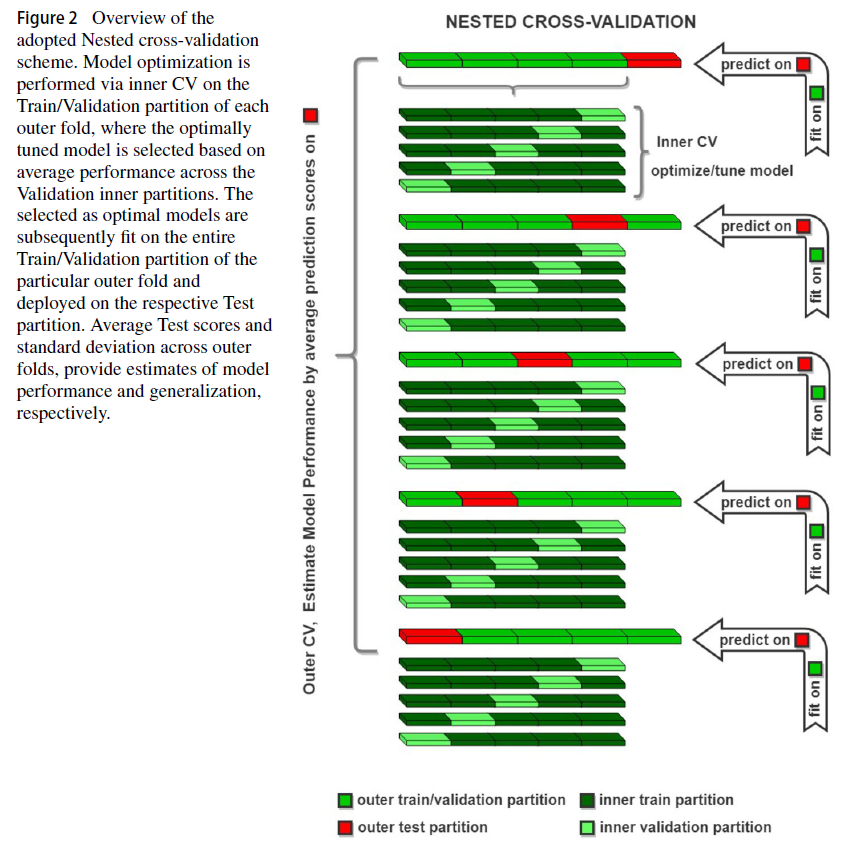
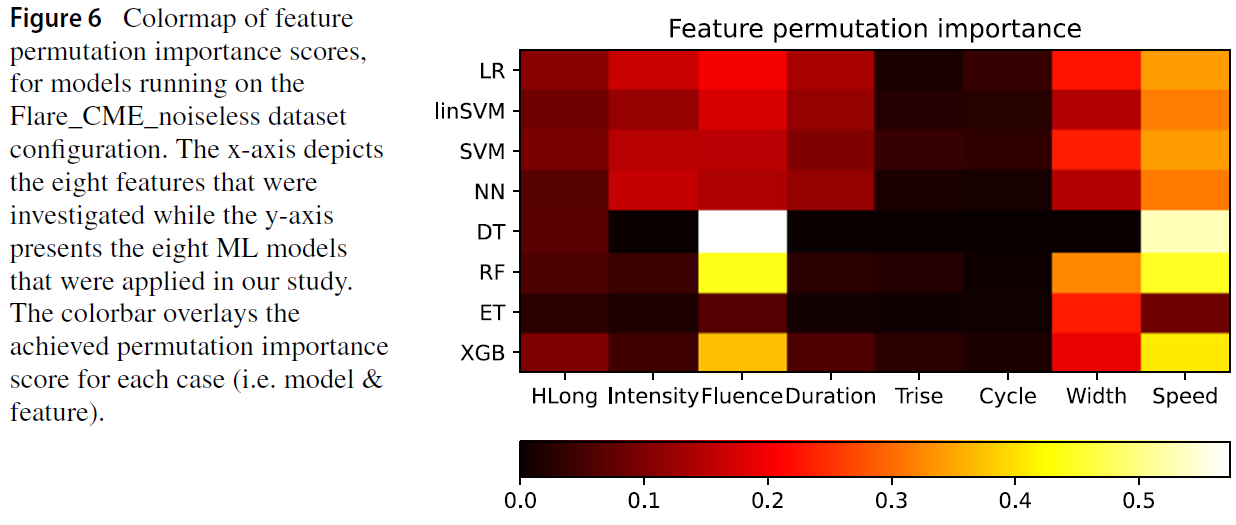
This paper approaches the prediction of SEPs using CME and Solar Flare features. The authors start with an initial sample analysis where they find that for about 33,221 Solar Flare events, 6218 are CMEs and only 257 are SEPs, illustrating the extreme imbalance in the data. Before applying any model to the data, they preprocess it and extract 8 features, 6 Solar Flare features and 2 CME features. They then normalize the features or apply the logarithm to make sure that the values and ranges of those features are manageable. They apply a Nested Cross Validation scheme where there is the inner folds for finding hyperparameters for the models and the outer folds for testing the found hyperparameters. It works by first spliting the dataset in K folds. They hold on out for testing and use the k-1 folds for training. Of the K-1 folds, the perform another n-folding where they divide the combined k-1 folds into n folds. They hold n one out for validation and train on the remaining n-1 folds. They train 8 machine learning including Linear models, SVMs, Neural Nets, and Decision Trees algorithms compare their relative performance in balanced and imbalanced settings. No clear winner can be declared as the algorithms trade wins over different metrics. They analyze the importance of the given features in the classification, finding out that Solar Flare fluence, CME speed and width are the most useful to predict SEPs.
Problem Using Solar Flares and CME features to predict SEPs
Solution, Ideas and Why Nested cross validation scheme where the find the hyperparams using the inner cross validation and test them using the outer cross validation used many ml models to classifier SEP events from solar flares and CME features
Images
-
Interpretable machine learning to forecast SEP events for solar cycle 23
BibTex
url=https://agupubs.onlinelibrary.wiley.com/doi/pdf/10.1029/2021SW002842
@article{kasapis2022interpretable,
title={Interpretable machine learning to forecast SEP events for solar cycle 23},
author={Kasapis, Spiridon and Zhao, Lulu and Chen, Yang and Wang, Xiantong and Bobra, Monica and Gombosi, Tamas},
journal={Space Weather},
year={2022}}
Summary
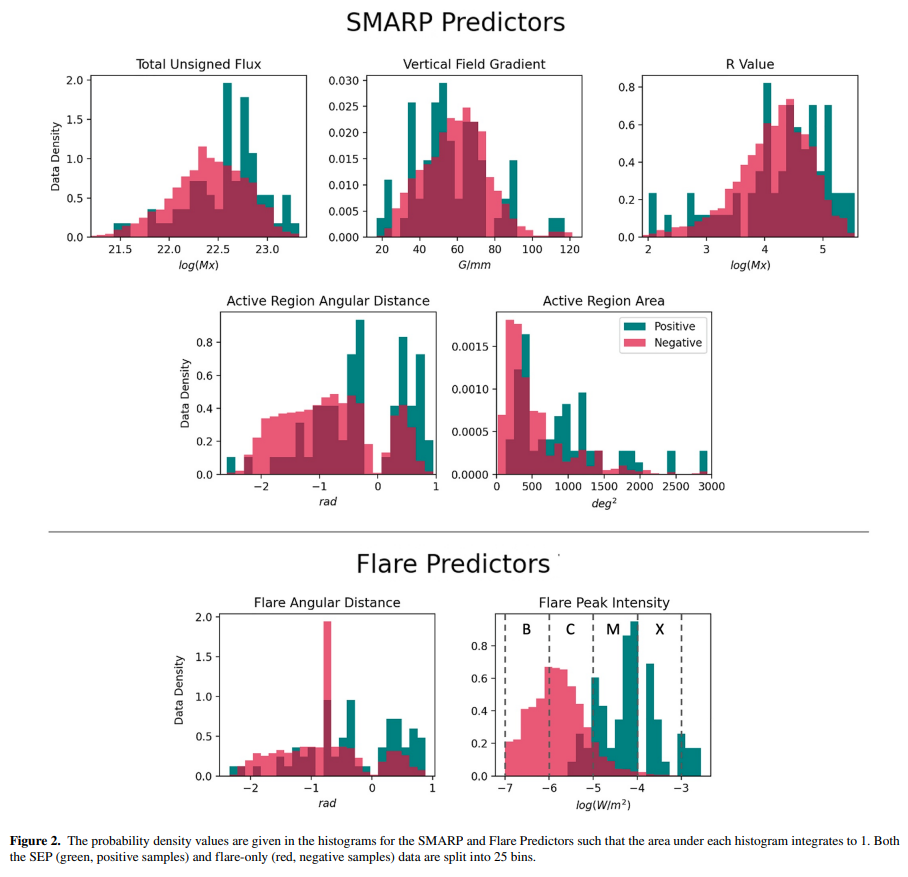
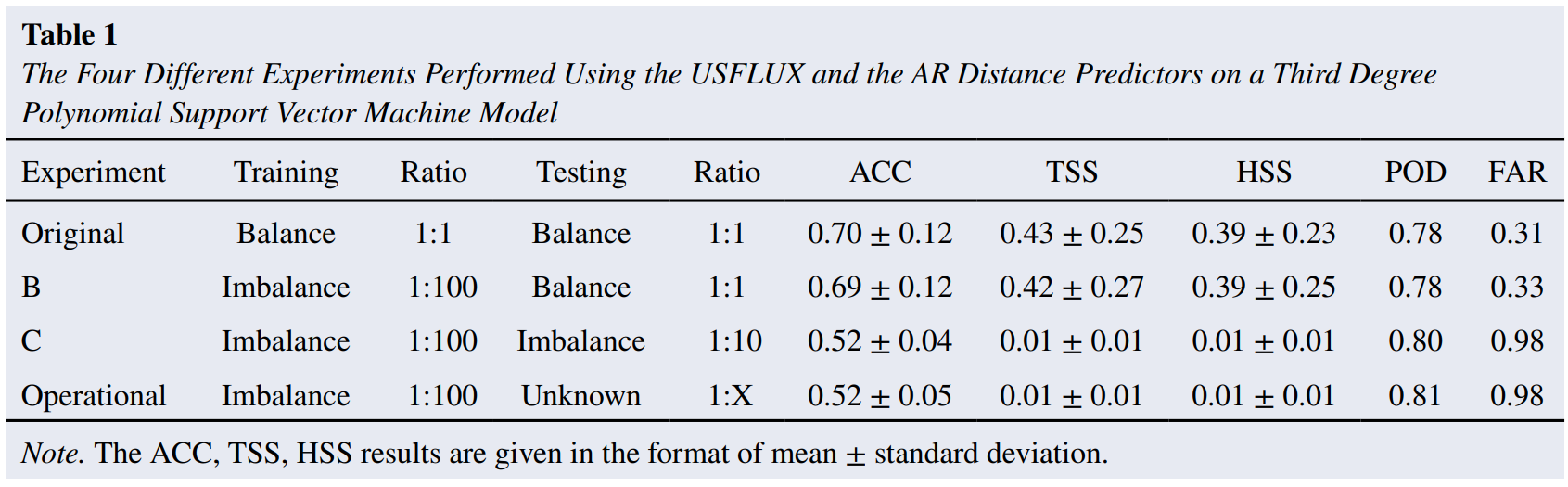
This paper addresses SEPs forecasting using SMARP Features and Solar Flare features. They first analyze Active Regions (AR) which are regions of high magnetic fields, and how these regions are related to Solar Flares and SEPs. They track 5 AR properties and 2 Solar Flare properties which are used as inputs to a Linear Model and an SVM. They train and test their models using balanced as well as imbalanced data, where the balancing is done by oversampling the rare samples. They found that they obtained the best performance by leveraging a subset of features from SMARP and Solar Flares that were the most discerning of SEP events. They found that the flares features performed better then the SMARP Active Region featuers. They also observe that the performance of the algorithms would drop significantly as the level of imbalance in training and testing increased.
Problem predicting SEPs from Solar Flares and SMARP (Active Regions) features
Solution, Ideas and Why Analyzed how SMARP Active region features and Solar Flares are correlated with SEP occurance. Use SVM and MLP to predict SEPs from subsets of features to find the optimal subset of features from SMARP and Solar Flares.
Images
-
Forecasting >100 MeV SEP Events and Intensity based on CME and other Solar Activities using Machine Learning
BibTex
url=https://cs.fit.edu/~pkc/theses/griessler23.pdf
@mastersthesis{griessler2023rtae,
author = {Griessler, Daniel Lee},
title = {Forecasting >100 MeV SEP Events and Intensity based on CME and other Solar Activities using Machine Learning},
school = {Florida Institute of Technology},
year = {2023},
address = {Melbourne, FL},
month = {July}}
Summary
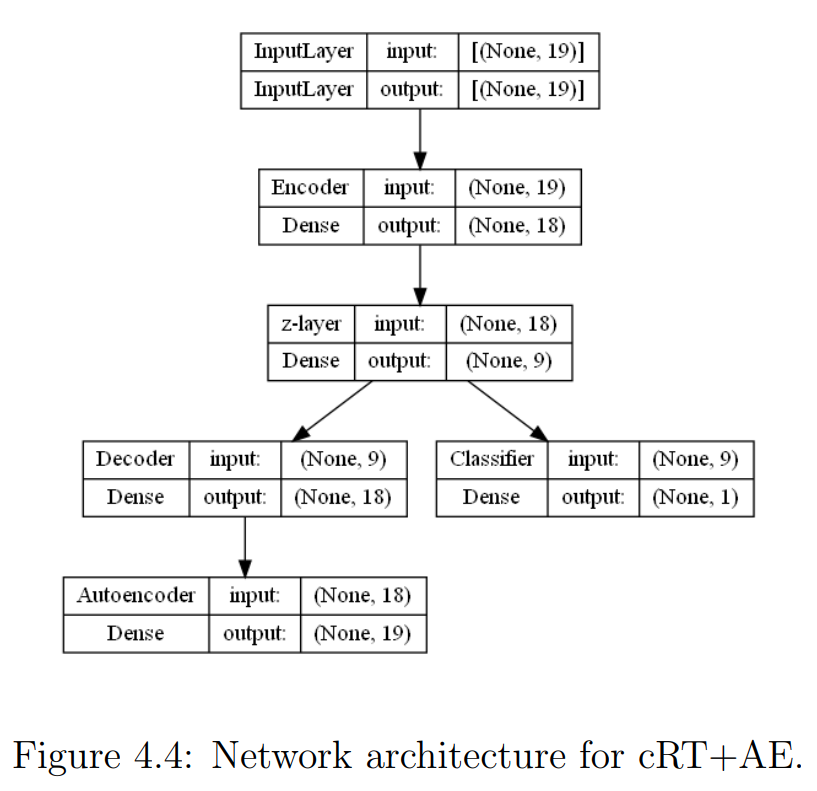
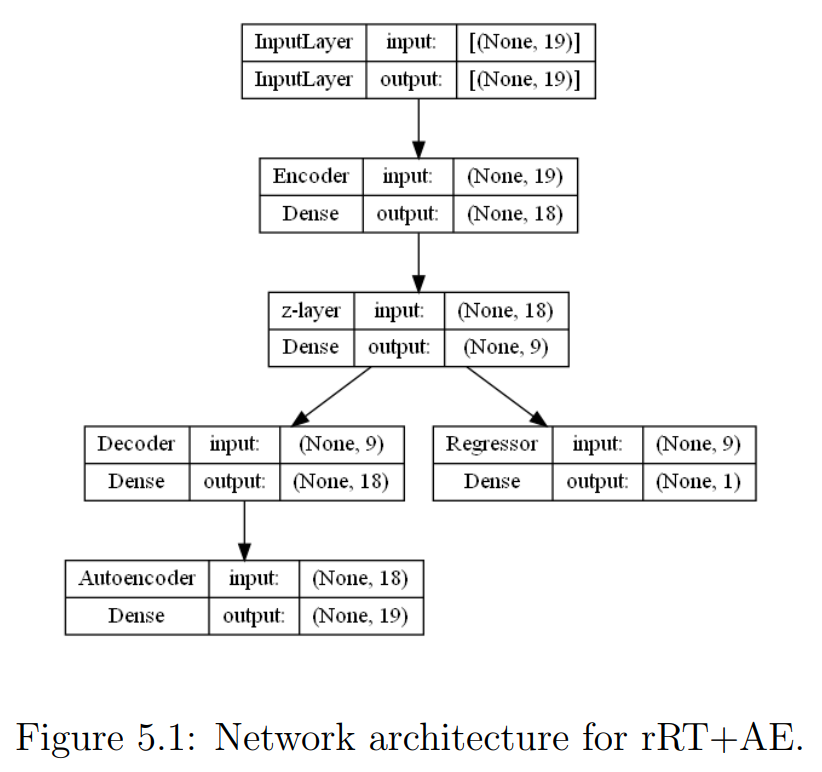
This thesis tackles the forecasting SEPs from non-SEPs and the intensity of the SEPs. For classifying SEPs using CME features, they explore 3 methods, oversampling the minority classes to obtain a more balanced dataset, apply classifier retraining (cRT) and an auto-encoder head to learn better features during the first stage (cRT+AE). For cRT+AE, they estimate the coefficient contribution of the auto-encoder loss to ensure both branches are equally valued in the training. They found cRT+AE to perform the best in their experiments. For predicting the SEP natural logarithm intensity, they explore 6 methods, oversampling the minority ranges, retraining the regressor (rRT), adding an auto-encoder head to learn better features during the first stage (rRT+AE), integrating the Richardson equation prediction by linear combination or by using the neural network to predict an adjustment error term to the Richardson prediction, and applying dense loss reweighting to the loss function so the training model pays more attention to rare samples. They evaluate their performance using Mean Absolute Error and Pearson Correlation Coefficient. They found that rRT+AE with either dense loss or Richardson adjustment error yielded the best results.
Problem Predicting SEPs using CME features, Solar Flares and X-rays
Solution, Ideas and Why Forecasting SEPs events and SEP intensity using various techniques to deal with imbalance Leveraging representation learning with an Auto-Encoder branch, the richardson equation, and the dense loss.
Images
-
Up to 1-hour forecasting of radiation hazards from solar energetic ion events with relativistic electrons
BibTex
url=https://agupubs.onlinelibrary.wiley.com/doi/epdf/10.1029/2006SW000268
@article{posner2007up,
author = {Posner, Arik},
title = {Up to 1-hour forecasting of radiation hazards from solar energetic ion events with relativistic electrons},
journal = {Space Weather},
year = {2007},
}
Summary
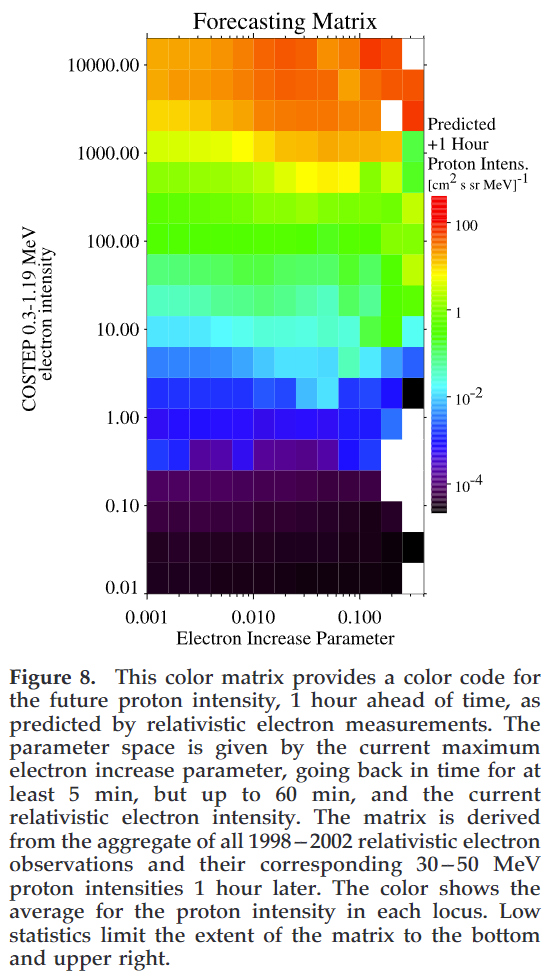
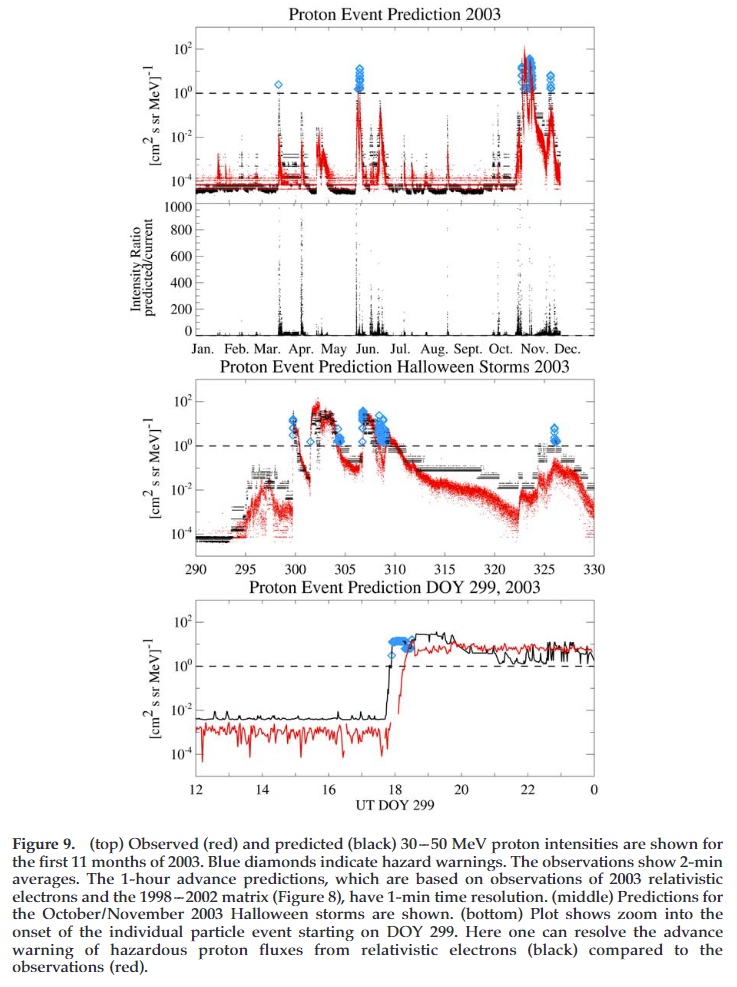
Posner's study addresses the need for a reliable forecasting method that can predict the arrival and intensity of hazardous solar energetic particle (SEP) events with a lead time sufficient to mitigate radiation risks for astronauts and spacecraft. The study establishes a methodology using relativistic electron data to forecast the onset and intensity of SEP protons at energies above 30-50 MeV, which can penetrate spacesuits and spacecraft shielding. By analyzing SEP events from 1996-2002, Posner demonstrates that relativistic electrons consistently arrive 30-60 minutes before hazardous SEP protons, and their intensity rise times are correlated, depending on the magnetic connection angle between the observer and the flare location. A forecasting matrix is developed using the electron intensity and maximum rise time parameter to predict the proton intensity 60 minutes in advance. The matrix, derived from historic data, is tested on events from 2003, demonstrating a high success rate in predicting hazardous SEP events with a low false alarm rate. This forecasting method provides a reliable solution for short-term SEP event prediction, enabling timely mitigation of radiation risks for human spaceflight and robotic missions.
Problem Current forecasting methods for solar energetic particle (SEP) events do not provide sufficient advance warning time for protons at energies that pose a radiation hazard to humans and spacecraft
Solution, Ideas and Why Relativistic electrons (0.3-1.2 MeV) consistently arrive 30-60 minutes before hazardous SEP ions (>30 MeV), providing a reliable precursor for advance warning. The rise times of both electron and proton intensities are correlated and depend on the magnetic connection angle between the observer and the flare location, with well-connected events showing faster rise times. A forecasting matrix is developed using the electron intensity and maximum rise time parameter to predict the proton intensity 60 minutes in advance.
Images