Classification
-
Decoupling Representation and Classifier for Long-Tailed Recognition
BibTex
url=https://iclr.cc/virtual_2020/poster_r1gRTCVFvB.html
@inproceedings{ kang2020decoupling,
title={Decoupling Representation and Classifier for Long-Tailed Recognition},
author={Kang, Bingyi and Xie, Saining and Rohrbach, Marcus and Yan, Zhicheng and Gordo, Albert and Feng, Jiashi and Kalantidis, Yannis},
booktitle={International Conference on Learning Representations},
year={2020}}
Summary
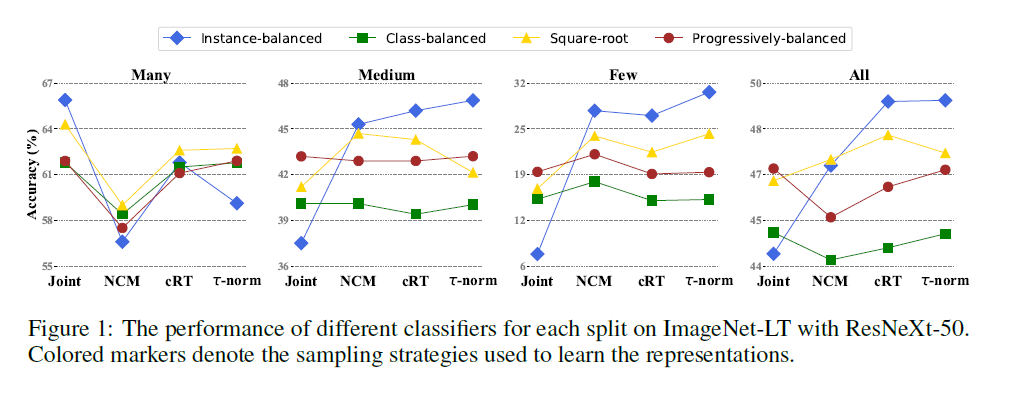
In this paper, the authors are tackling the problem of classification on long-tail datasets. The authors propose decoupling representation learning and classifier learning for long-tail data distributions unlike previous methods which would train a model jointly for both representation and classifier learning. One advantage of decoupling that the autors point out is the ability to use different sampling techniques for the stages and see which sample technique benefit best each stage. To that end, The authors setup a Convolutional Neural Network which is composed of a backbone for representation learning and a classifier head, either linear model or a MultiLayer Perceptron, for classification. They then employ various sampling techniques for both parts independently. For learning representations, the sampling techniques are
- Instance balanced sampling: each training example has equal probability of being sampled. As a results classes with greater number of samples dominate the training process.
- Class-balanced sampling: it occurs in two steps where a class is uniformly selected from the set of all classes and then the sample is uniformly selected from the selected class. This sampling technique is used to balance the number of samples per class.
- Square-root sampling: where the Square-root of the number of examples is considered instead of the number of examples itself.
- Progressively balanced sampling: it's a mix of Instance balanced sampling and Class balanced sampling. Using the iteration number (epoch number), the sampling can start with Instance balanced sampling and then gradually shift to Class balanced sampling. Unfortunately, this technique requires the total number of iterations to be known ahead of time.
For classifier learning, the approaches are
- cRT: Classifier Re-training where the classifier head is retrained on class-balanced sampling
- Nearest Class Mean Cluster: where a new example is classified based on its proximity to the nearest class cluster mean. This technique rely more heavily on the quality of the representation learning.
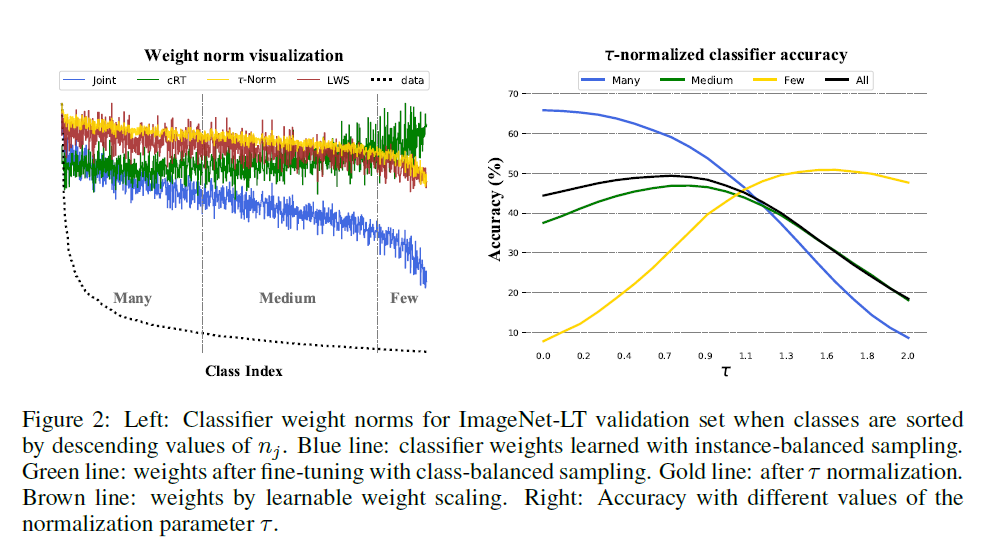
- tau normalized classifier: where the norms of the classifier weights associated with each class are normalized to to prevent the majority classes' weight to grow dominant as they normally would
- LWS: Learnable Weights Scaling takes that step further and makes to normalization coefficient of the class associated weights learnable
After the test on few long-tail datasets, the authors show that data imbalance is not an issues for learning high quality representations. Moreover, representation learning is not affected by tail distribution but rather takes advantage of the instance-balanced distribution. But classifier learning is affected by the tail distribution and therefore needs to be balanced. The best coupling the found was instance-balanced sampling for representation learning and some balancing for classifier learning (cRT, tau-normalized, LWS).Problem imbalanced input distribution cause the model to be biased towards the majority classes and therefore perform poorly on the minority classes.
Solution, Ideas and Why The authors main approach is to decouple the representation learning and classifier learning. That way, a different sampling technique can be applied to the representation learning and the classifier learning. The authors show that representation learning is not affected by tail distribution and therefore can leverage all data points. It's actually best for the representation learning to use instance-balanced sampling. The classifier can then be adapted to the imbalance of the data through few method that the author compared. The ones that work the best are cRT (classifier retraining where the classifier is retrained on a class-balanced sampling), thau-normalized (where the classifier's weights are normalized inversely proportional to the class frequency), and LWS (learnable weight scaling where the thau normalized factor is learned).
Images
-
BBN: Bilateral-Branch Network with Cumulative Learning for Long-Tailed Visual Recognition
BibTex
url= https://openaccess.thecvf.com/content_CVPR_2020/papers/Zhou_BBN_Bilateral-Branch_Network_With_Cumulative_Learning_for_Long-Tailed_Visual_Recognition_CVPR_2020_paper.pdf
@inproceedings{ zhou2020bbn,
title={Bbn: Bilateral-branch network with cumulative learning for long-tailed visual recognition},
author={Zhou, Boyan and Cui, Quan and Wei, Xiu-Shen and Chen, Zhao-Min},
booktitle={Proceedings of the IEEE/CVF conference on computer vision and pattern recognition},
year={2020}}
Summary
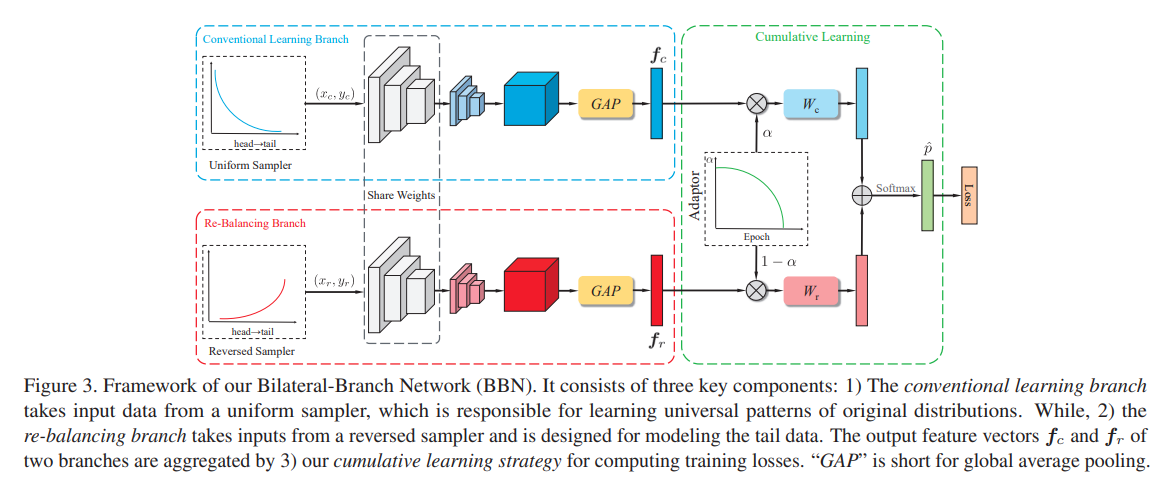
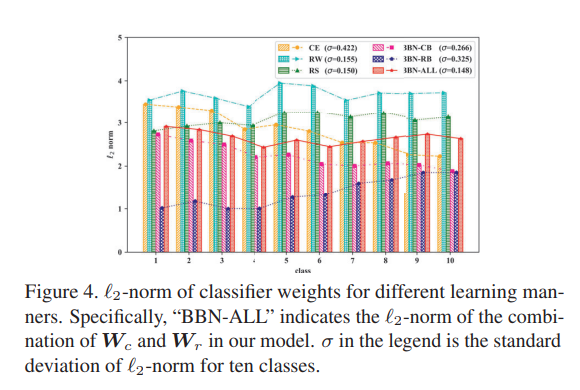
In this paper, the authors are tackling the problem of classification on long-tail data distributions. They observed that balancing methods (when performed jointly) promote minority classes at the expense of the majority classes. They show through their experiments that for representation learning, using the original long-tail distribution has the least error rate overall, while for classifier learning, using a balanced distribution has the least error rate overall. In an effort to reconcile the two, they propose a bilateral-branch network (BBN) that has two branches: one branch called the convential branch that cares about learning the original distribution for strong representation learning, and another branch called the re-balancing branch that cares about learning a reverse distribution (minority classes are more likely to be sampled) for strong classifier learning. It's crucial to note that both branches share the same weights for the representation learning backbone. Both branches would then be combined through a cumulative learning strategy. The cumulative learning strategy features two classifier from both branches. A classifier from the conventional branch to classify majority classes and a classifier from the re-balancing branch to classify minority classes. The cumulative learning strategy is a weighted sum of the two branches' outputs. That weight is modulated by the iteration number and follows a parabolic decay. Early in the training, more weight is given to the conventional branch and much later in the training, more weight is given to the re-balancing branch. The authors also propose a weighted cross-entropy loss that accompany the cumulative learning strategy. During inference, both branches are considered equally and the final prediction is the average of the two branches' predictions. Their results show that their soft decoupling by transitioning from conventional learning to re-balancing learning is better than technique prior. The norms of the classifier weights are also shown to be more balanced, with a lower standard deviation, than the prior techniques.
Problem imbalanced input distribution cause the classifier to be biased towards majority classes even though the feature extractor is performant under the original distribution.
Solution, Ideas and Why
Images
2 branches are used: one branch for representation learning and another branch for classifier learning. The representation learning branch is trained on the original distribution while the classifier learning branch is trained on a reverse distribution. The two branches are then combined through a cumulative learning strategy where the weight of each branch is modulated by the iteration number according to a curriculum.
-
Balanced Meta-Softmax for Long-Tailed Visual Recognition
BibTex
url= https://proceedings.neurips.cc/paper_files/paper/2020/file/2ba61cc3a8f44143e1f2f13b2b729ab3-Paper.pdf
@inproceedings{ ren2020balsoftmax,
title={Balanced Meta-Softmax for Long-Tailed Visual Recognition},
author={Ren, Jiawei and Yu, Cunjun and sheng, shunan and Ma, Xiao and Zhao, Haiyu and Yi, Shuai and Li, hongsheng},
booktitle={Advances in Neural Information Processing Systems},
year={2020}}
Summary
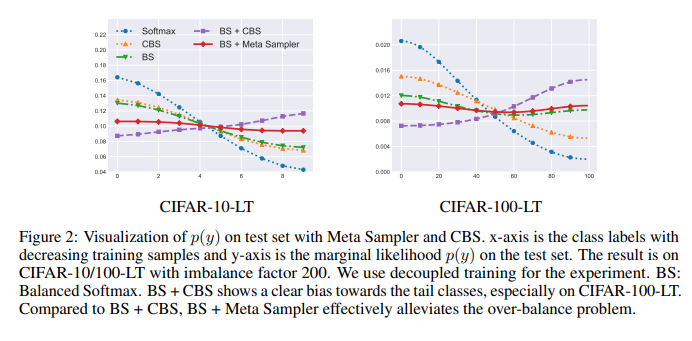
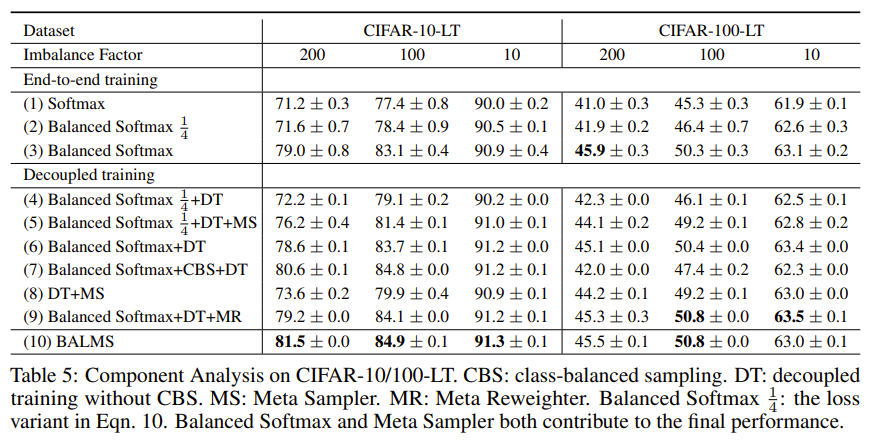
The authors are tackling the problem of classification on long-tail data distributions. They observed that the softmax function is not well suited for long-tail data distributions as it gives bias gradient estimates under long-tail data distributions. They therefore propose a balanced softmax function that is only used during training while the conventional softmax function is used during testing or inference (in deployment). Utilizing the bayesian definition of the softmax function, they propose a balanced softmax function that is softmax with the number of samples in each class a coefficient to the exponential. This formulation of a balanced softmax during training forces the training network to output larger logits for minority classes. However, paired with a class balanced strategy, the authors observed that minority classes were overbalanced. They needed a new sampling strategy that would work with the balanced softmax function. The proposed a meta sampler, a model that could learn that optimal sampling strategy for the balanced softmax function during training. The training routine would be in two level where the first level would be the training of the meta sampler in the inner training loop and then the training of the network in the outer training loop. The algorithmic steps are as follows:
- Obtain a minibach sampled with the meta sampler from the training set and use that minibach to train a surrogate network. The surrogate network is used there to ensure the real network can be trained with a better batch from the meta sampler later. This step is done once per outer loop iteration
- A loss for the surrogate network is computed on a class balanced dataset with softmax and cross entropy and the value of the loss was used to update the meta sampler. This update is performed a few times per outer loop iteration.
- The improved sampled is then used to sample a new batch for the real network to train on. This step is done once per outer loop iteration.
Problem output logits are not balanced for long-tail data distributions, majority classes have larger logits than minority classes. This may lead to poor performance on minority classes.
Solution, Ideas and Why The authors propose a balanced softmax function that is only used during training. The balanced softmax function is softmax with the number of samples in each class a coefficient to the exponential. This formulation of a balanced softmax during training forces the training network to output larger logits for minority classes. However, paired with a class balanced strategy, the authors observed that minority classes were overbalanced. A meta sampler is proposed to learn the optimal sampling strategy for the balanced softmax function during training. The training routine would be in two level where the first level would be the training of the meta sampler in the inner training loop and then the training of the network in the outer training loop.
Images
-
Exploring balanced feature spaces for representation learning
BibTex
url=https://openreview.net/pdf?id=OqtLIabPTit
@inproceedings{ kang2021kcl,
title={Exploring balanced feature spaces for representation learning},
author={Kang, Bingyi and Li, Yu and Xie, Sa and Yuan, Zehuan and Feng, Jiashi},
booktitle={International Conference on Learning Representations},
year={2021}}
Summary
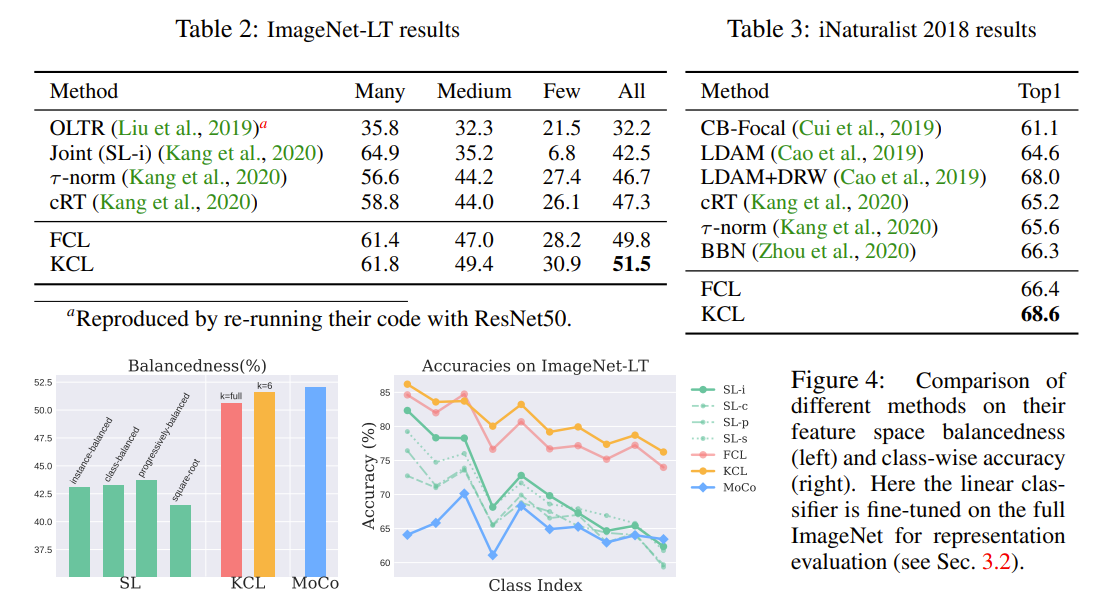
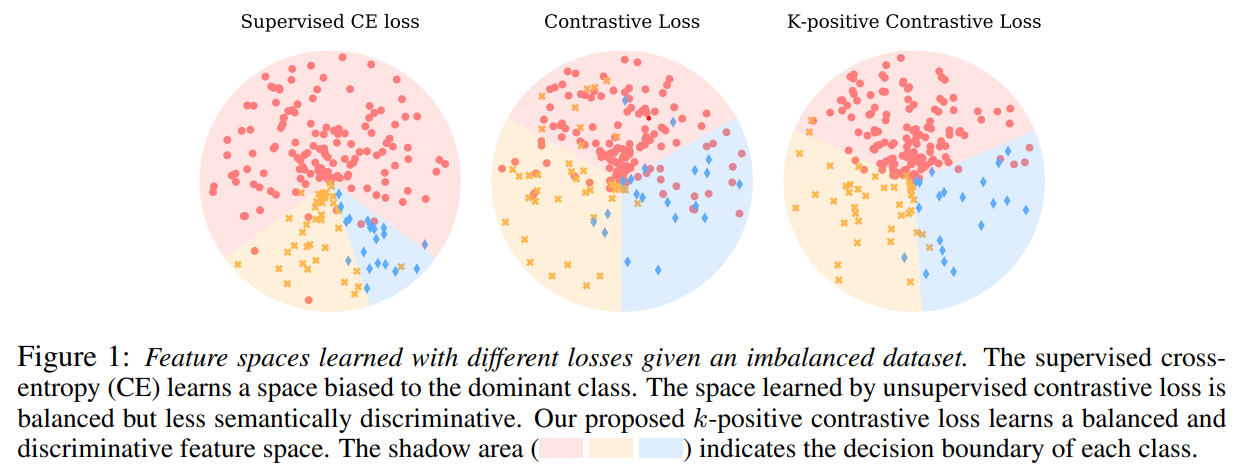
The authors are tackling the issue of imbalance feature space for long-tail data distributions. They observed that the feature space is imbalanced under long-tail data distributions which leads to poor decision boundaries for minority classes when using Supervised Cross Entropy loss. They observed that with contrastive loss, the feature space is balanced. They therefore propose a supervised contrastive learning method that uses the labels of the data to learn a representation space where similar samples are close to each other and dissimilar samples are far from each other. The supervised contrastive loss use class label to draw samples from the same class close to each other and samples from different classes far from each other. The noticed however that, with a large number of samples, the majority classes would dominate the learning process. they then proposed K contrastive learning (KCL) that limits the number of positive samples from each class to K to prevent the majority classes from dominating the learning process with more samples. They showed their methods also works on other tasks such as object detection and semantic segmentation. a proposed a balancedness metric to measure the balance of the feature space.
Problem under long tail distribution, the feature space is imbalanced which leads to poor decision boundaries for minority classes.
Solution, Ideas and Why supervised contrastive learning to learn a balanced feature space. Supervised contrastive learning is a contrastive learning method that uses the labels of the data to learn a representation space where similar samples are close to each other and dissimilar samples are far from each other. K contrastive learning (KCL) is a supervised contrastive learning method that the limit of the number of samples from each class to K to prevent the majority classes from dominating the learning process with more samples.
Images
-
Long-tail learning via logit adjustment
BibTex
url=https://openreview.net/pdf?id=37nvvqkCo5
@inproceedings{ menon2021logitadjustment,
title={Long-tail learning via logit adjustment},
author={Menon, Aditya Krishna and Jayasumana, Sadeep and Rawat, Ankit Singh and Jain, Himanshu and Veit, Andreas and Kumar, Sanjiv},
booktitle={International Conference on Learning Representations},
year={2021}}
Summary
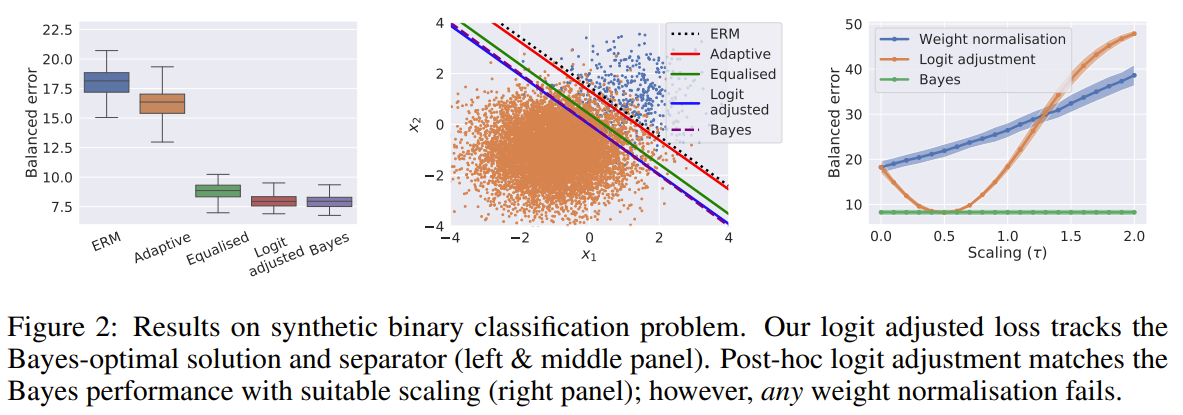
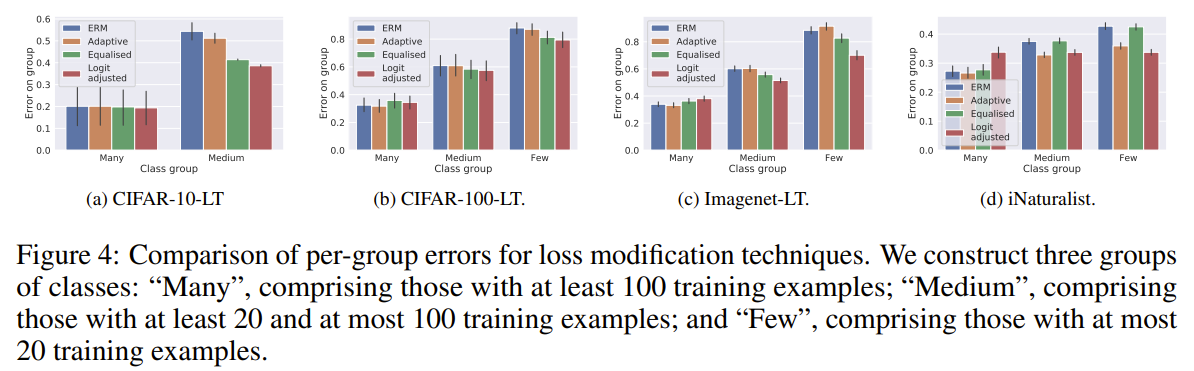
The authors propose a framework to generalize on the logit adjustment methods. They observed that previous methods focused on scaling the logits and assumed the target distribution is uniform. They propose a logit adjustment framework that can be implemented post hoc to any existing model where an adjustment term based on the prior distribution of the target dataset is added to the logits. It can also be implemented as a loss function. The loss function would be adjusted based on added terms that would take into account the known prior of the target dataset. The authors showed that their method indeed was a general formulation of previous methods and that it outperformed previous methods on benchmark datasets.
Problem logits are not balanced for long-tail data distributions, majority classes have larger logits than minority classes. furthermore, previous attempts at adjusting logits focus on scaling the logits and assumed the target distribution is uniform
Solution, Ideas and Why a logit adjustment framework that can be implemented post hoc to any existing model where an adjustment term based on the prior distribution of the target dataset is added to the logits. It can also be implemented as a loss function.
Images
-
Long-tailed Recognition by Routing Diverse Distribution-Aware Experts
BibTex
url=https://openreview.net/pdf?id=D9I3drBz4UC
@inproceedings{ wang2020ride,
title={Long-tailed Recognition by Routing Diverse Distribution-Aware Experts},
author={Wang, Xudong and Lian, Long and Miao, Zhongqi and Liu, Ziwei and Yu, Stella},
booktitle={International Conference on Learning Representations},
year={2020}}
Summary
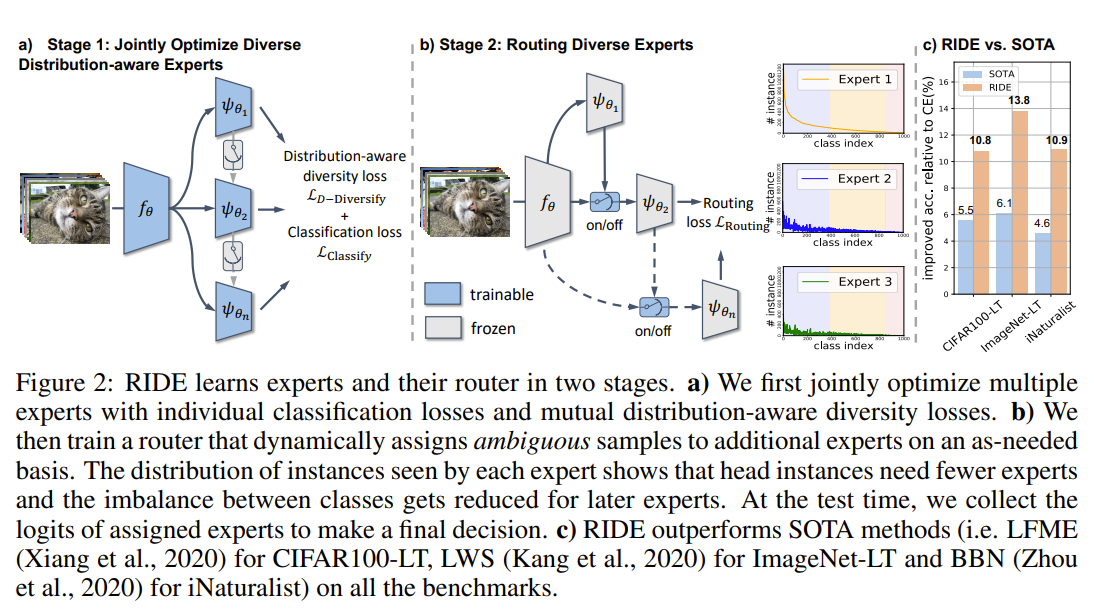
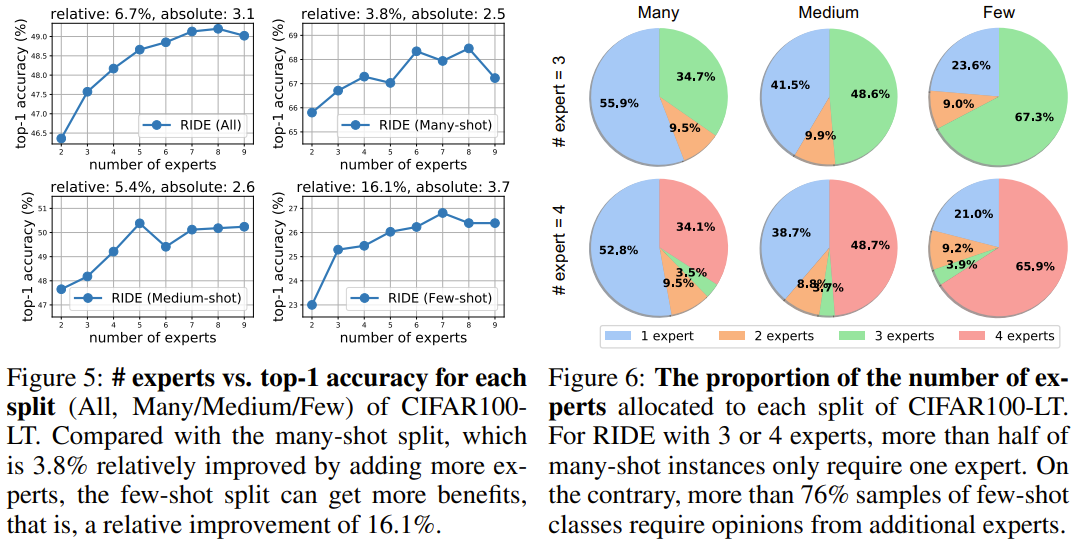
This paper demonstrate that prior methods that tackle the long-tail problem by focusing on the balacing the classifier decrease tail bias at the expense of increased head bias, and increased variance for all classes. They tackle this issue with an ensemble of experts that are trained on balanced data and to be diverse ie their posteriors distribution are divergent. To make sure not too many experts are used which would take too much compute, they use a router that predicts whether to involve additional experts in the classification. The router network is trained to route to the next expert if the current expert incorrectly classify but some kth expert correctly classify the sample. They optionally apply self distillation to distill many experts into fewer experts.
Problem imbalance classification and focusing reduce tail bias at expense of increased head bias, increase variance for all classes
Solution, Ideas and Why use multiple experts to reduce variance, and add loss term to increase experts diversity and reduce bias. learne router to predict whether to involve additional experts in the classification
Images
-
Contrastive Learning based Hybrid Networks for Long-Tailed Image Classification
BibTex
url= https://openaccess.thecvf.com/content/CVPR2021/papers/Wang_Contrastive_Learning_Based_Hybrid_Networks_for_Long-Tailed_Image_Classification_CVPR_2021_paper.pdf
@inproceedings{ wang2021hybridsc,
title={Contrastive learning based hybrid networks for long-tailed image classification},
author={Wang, Peng and Han, Kai and Wei, Xiu-Shen and Zhang, Lei and Wang, Lei},
booktitle={Proceedings of the IEEE/CVF conference on computer vision and pattern recognition},
year={2021}}
Summary
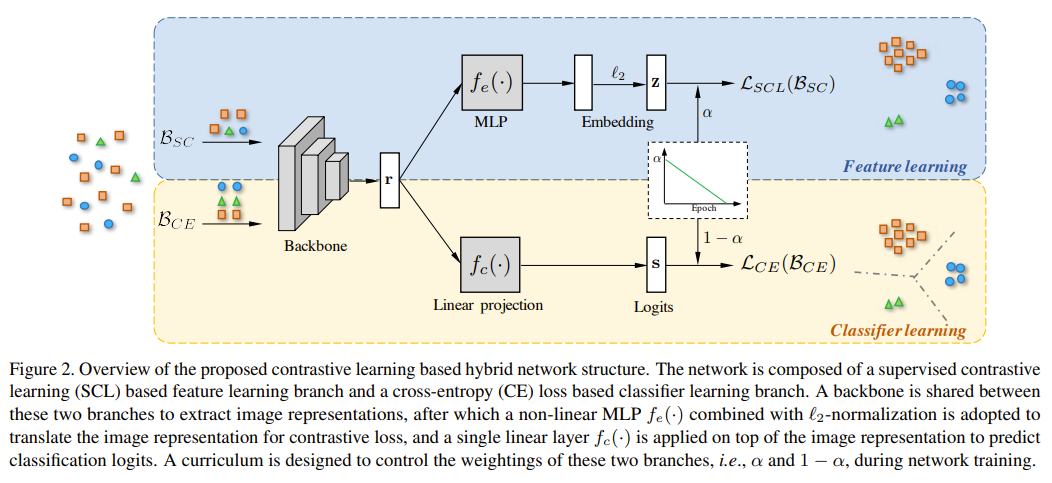
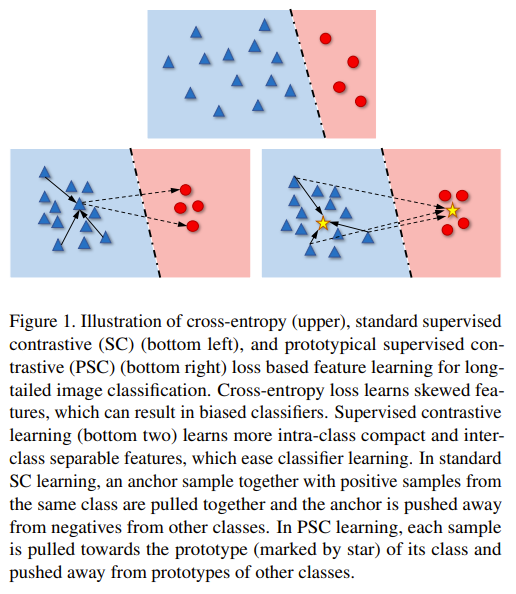
This paper tackle imbalance classification and the memory inefficiency observed in current supervised contrastive learning methods where they require large amount of negative samples. To tackle this issues, they propse a 2 branch network with a shared backbone. One branch is trained on imbalanced data samples with an MLP to produce embedding based on supervised contrastive loss that leverages class prototypes as positive and negative samples. The other branch is trained on balanced data samples with a linear layer to produce good decision boundaries for the features based on supervised cross entropy loss. The 2 branches are trained in a curriculum fashion with alpha controlling the balance between the 2 branches. Alpha decays as linearly with the epochs, indicating the training starts first with the feature learning branch and then gradually shift to the classifier learning branch. More than one prototype per class can be used to improve the performance of the feature learning branch (still fewer in number compared to negative samples needed). The prototypes are learned.
Problem memory ineffficient feature learning
Solution, Ideas and Why use class prototypes in supervised contrastive loss. 2 branches and curriculum training from one to the other
Images
-
Disentangling Label Distribution for Long-tailed Visual Recognition
BibTex
url= https://openaccess.thecvf.com/content/CVPR2021/papers/Hong_Disentangling_Label_Distribution_for_Long-Tailed_Visual_Recognition_CVPR_2021_paper.pdf
@inproceedings{ hong2021disentangling,
title={Disentangling label distribution for long-tailed visual recognition},
author={Hong, Youngkyu and Han, Seungju and Choi, Kwanghee and Seo, Seokjun and Kim, Beomsu and Chang, Buru},
booktitle={Proceedings of the IEEE/CVF conference on computer vision and pattern recognition},
year={2021}}
Summary
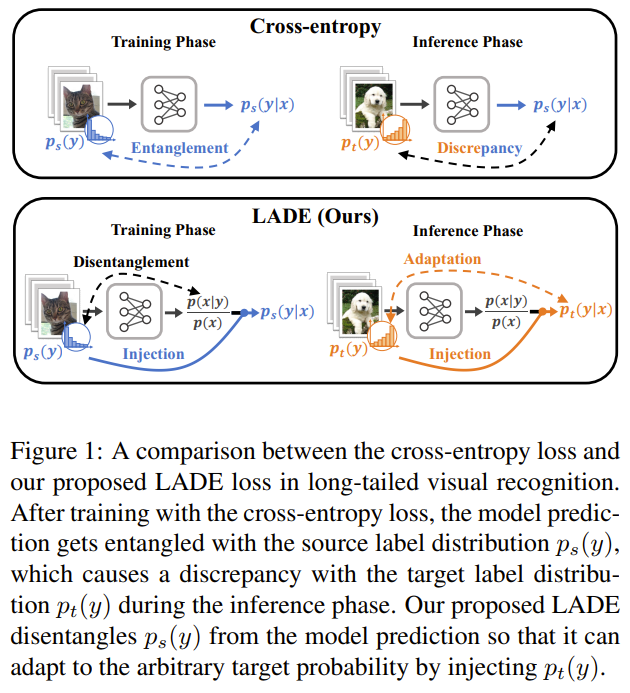
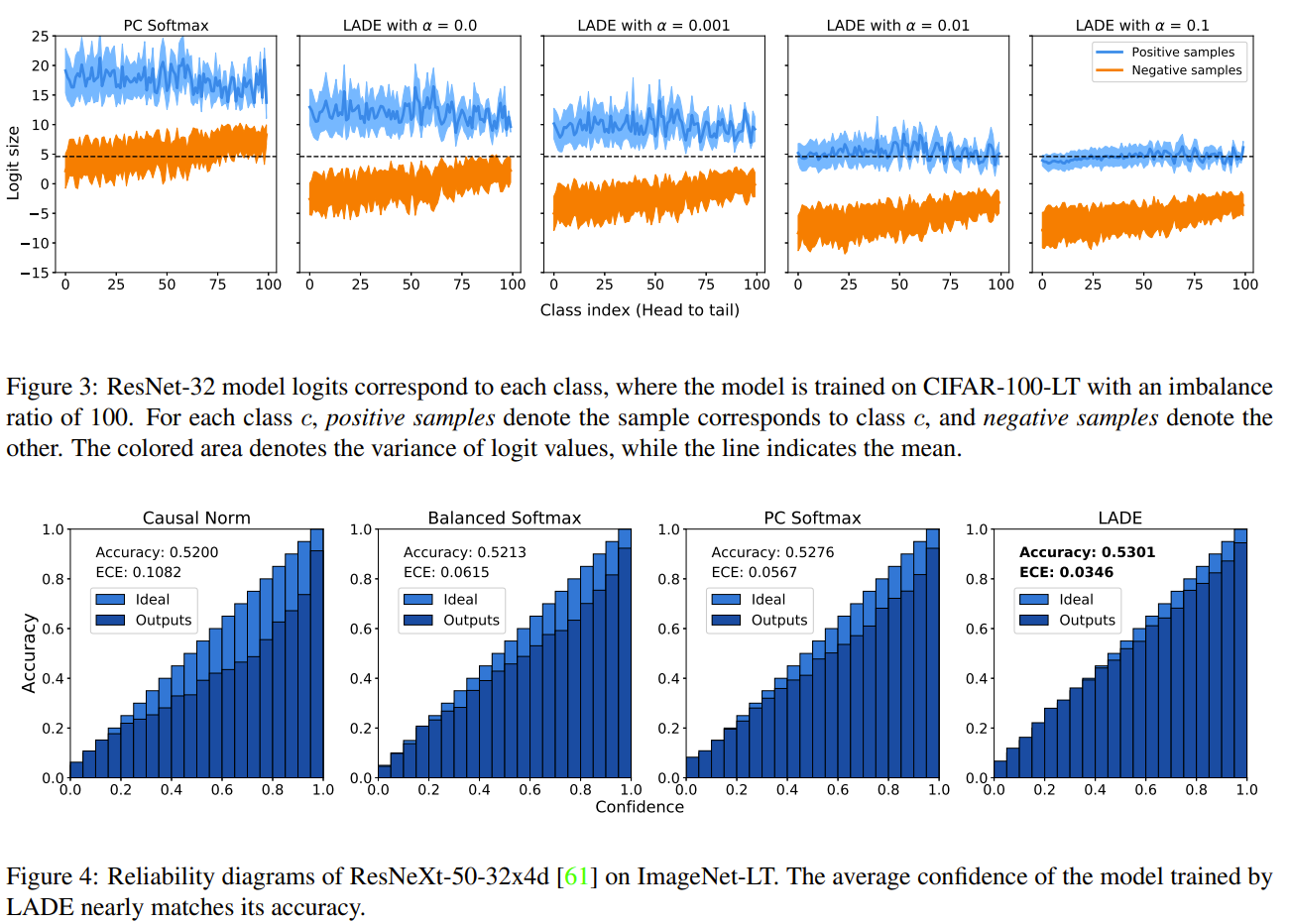
To tackle imbalance classification, the authors notice that previous methods focus on assumed uniform target distribution. They propose to not assume the target distribution is uniform but still known. Based on that, they reframe the problem as a distribution shift problem and disentangle the source distribution and logits by having logits represent likehood over evidence instead of posterior. Knowning the test distribution they can obtain a balanced output posterior by using the test distrubution prior and the network logits. They add a regulariser term to explicitly disentangle logits from source label distribution and use known target label distribution to post compensate.
Problem target distrubution may not be assumed uniform like many works do
Solution, Ideas and Why frame LT as distribution shift, disentangle source distribution and logits by having logits represent likehood over evidence instead of posterior. add a regulariser term to explicitly disentangle logits from source label distribution and use known target label distribution to post compensate
Images
-
Distribution Alignment: A Unified Framework for Long-tail Visual Recognition
BibTex
url= https://openaccess.thecvf.com/content/CVPR2021/papers/Zhang_Distribution_Alignment_A_Unified_Framework_for_Long-Tail_Visual_Recognition_CVPR_2021_paper.pdf
@inproceedings{ zhang2021disalign,
title={Distribution alignment: A unified framework for long-tail visual recognition},
author={Zhang, Songyang and Li, Zeming and Yan, Shipeng and He, Xuming and Sun, Jian},
booktitle={Proceedings of the IEEE/CVF conference on computer vision and pattern recognition},
year={2021}}
Summary
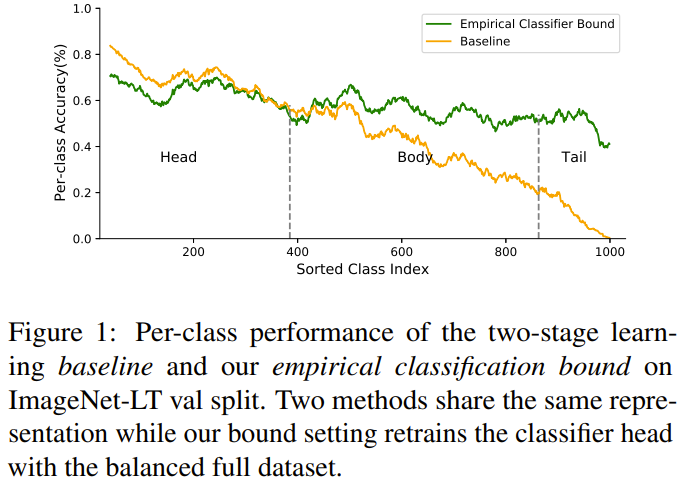
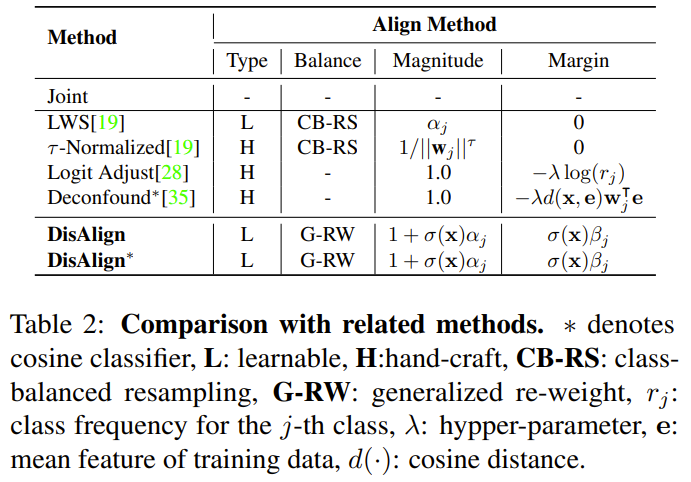
This paper is tackling the problem of imbalance classification. They first start by setting up the upper bound of the classification by including the test set in the dataset, making the test set known and observed that the upper bound is not achieved by current methods. They then propose a unified framework that learns a balanced network in 2 stages. First they learn an adaptive calibration function that would linearly project frozen classifier logits to a balanced space. To determine how much of calibration to use on the logit, they use a linear function with 2 learnable parameters that determine how much of the calibrated logits to use or the original logits based on the input data sample. This method effectively achieve class and instance level calibration of logits, as well as affine transformation of logits. They frame the problem as a distribution shift between training distribution (imbalanced) and target distribution (balanced), and minimize the KL divergence between the 2 distributions, with test distribution being the target distribution. The target distribution they conceived is a reweighted version of the training distribution. The reweighting is done by using the inverse of the class frequency so rare classes are weighted more than frequent classes.
Problem imbalanced output logits
Solution, Ideas and Why Learn affine logits adjustment at both class and instance levels. Adjuste target posterior based on class weighting for logits to approximate.
Images
-
Improving Calibration for Long-Tailed Recognition
BibTex
url= https://openaccess.thecvf.com/content/CVPR2021/papers/Zhong_Improving_Calibration_for_Long-Tailed_Recognition_CVPR_2021_paper.pdf
@inproceedings{ zhong2021mislas,
title={Improving calibration for long-tailed recognition},
author={Zhong, Zhisheng and Cui, Jiequan and Liu, Shu and Jia, Jiaya},
booktitle={Proceedings of the IEEE/CVF conference on computer vision and pattern recognition},
year={2021}}
Summary
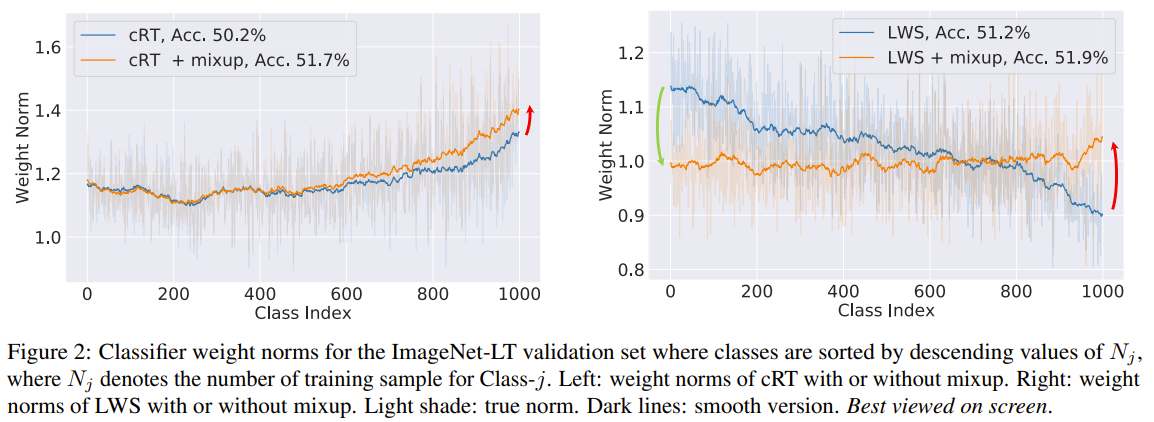
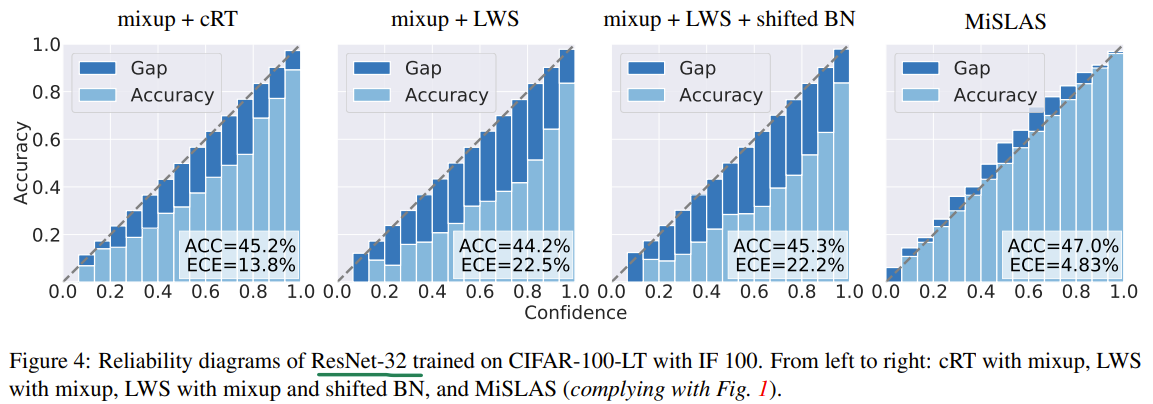
The authors are tackling the problem of imbalance classification. They observed that current methods have poor calibration of their output logits and are overconfident in their predictions. Usually by measuring the true accuracy against the predicted accuracy, the true accuracy is lower than the predicted accuracy. They also measure the ECE or expected calibration error and observed that the ECE is high for current methods (lower being better). First they propose to use Mixup to generate synthetic samples for the rare classes. Then they also propose label smoothing of the classifier logits by artificially deducting some epsilon value on the correct class logit and redistributing that value to the other classes uniformally. Epsilon is obtained as a function of the class sample count with some normalization by the difference between the maximum and minimum class sample counts. To fit the label aware smoothing objective, they combine cRT and LWS into classifier update function. It can either scale the classifier logits (LWS) or apply a learned update on the classifier weights (cRT) based on the retention factor r. For better normalization on stage 2, they update the running mean and variance in batch norm but fix the alpha and beta parameters in stage 2 (classifier update stage).
Problem miss-calibration of output logits which leads to over-confidence in majority classes, where the true accuracy is lower than the predicted accuracy.
Solution, Ideas and Why adjust target posterior as a function of class frequency. use mixup to generate synthetic samples, and use a combination of LWS and cRT to calibrate the output logits.
Images
-
RSG: A Simple but Effective Module for Learning Imbalanced Datasets
BibTex
url= https://openaccess.thecvf.com/content/CVPR2021/papers/Wang_RSG_A_Simple_but_Effective_Module_for_Learning_Imbalanced_Datasets_CVPR_2021_paper.pdf
@inproceedings{ wang2021rsg,
title={Rsg: A simple but effective module for learning imbalanced datasets},
author={Wang, Jianfeng and Lukasiewicz, Thomas and Hu, Xiaolin and Cai, Jianfei and Xu, Zhenghua},
booktitle={Proceedings of the IEEE/CVF Conference on Computer Vision and Pattern Recognition},
year={2021}}
Summary
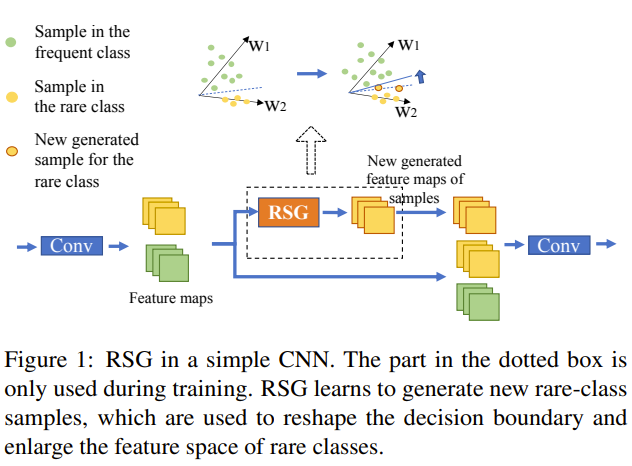
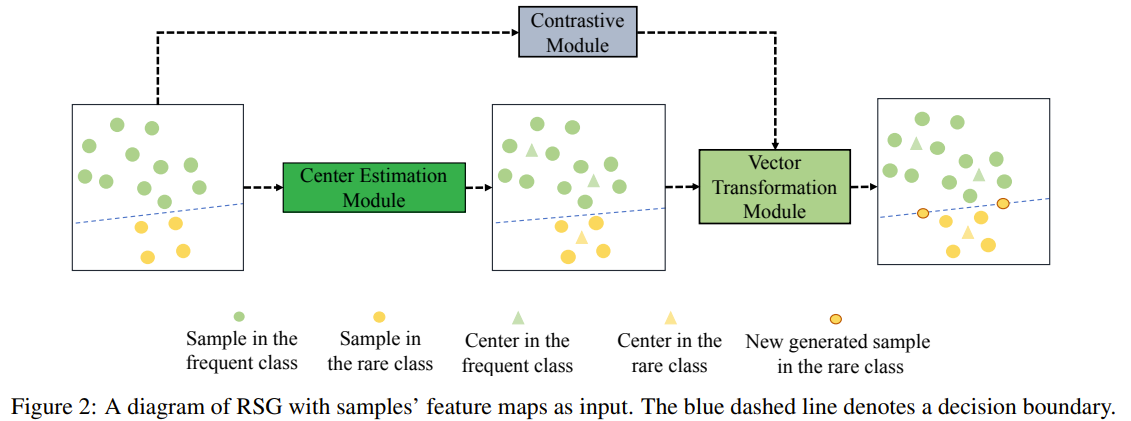
In this paper, the authors propose a simple but effective module called RSG to address the long-tail problem. RSG works by generating new samples for the rare classes. RSG uses variation information among the real samples from the frequent classes to generate new samples for the rare classes. RSG is composed of 3 modules:
- Center estimation module: to find class feature centers
- Contrastive module: to check if 2 feature maps are from the same class
- Vector Transformation module: generate new rare samples with displacement vectors
Problem Current methods on long-tail recognition lacks good generalization because they are not trained end to end, and variation information used to produce new synthetic data sample are not class-irrelevent.
Solution, Ideas and Why
- Rare-class sample generator which can be trained end to end
- Assuming class samples follow a multinomial distribution so there can be center(s) for each class
- Feature displacement indicates the displacement of a sample to its corresponding center in a class and should not contain class-relevent information
- Adding feature displacement vector to rare-class samples instead of centers to improve the decision boundary
- Transformed freq class displacement vector should be collinear to rare-class displacement vector of the sample to be applied to
-
Balanced Contrastive Learning for Long-Tailed Visual Recognition
BibTex
url= https://openaccess.thecvf.com/content/CVPR2022/papers/Zhu_Balanced_Contrastive_Learning_for_Long-Tailed_Visual_Recognition_CVPR_2022_paper.pdf
@inproceedings{ zhu2022bcl,
title={Balanced contrastive learning for long-tailed visual recognition},
author={Zhu, Jianggang and Wang, Zheng and Chen, Jingjing and Chen, Yi-Ping Phoebe and Jiang, Yu-Gang},
booktitle={Proceedings of the IEEE/CVF Conference on Computer Vision and Pattern Recognition},
year={2022}}
Summary
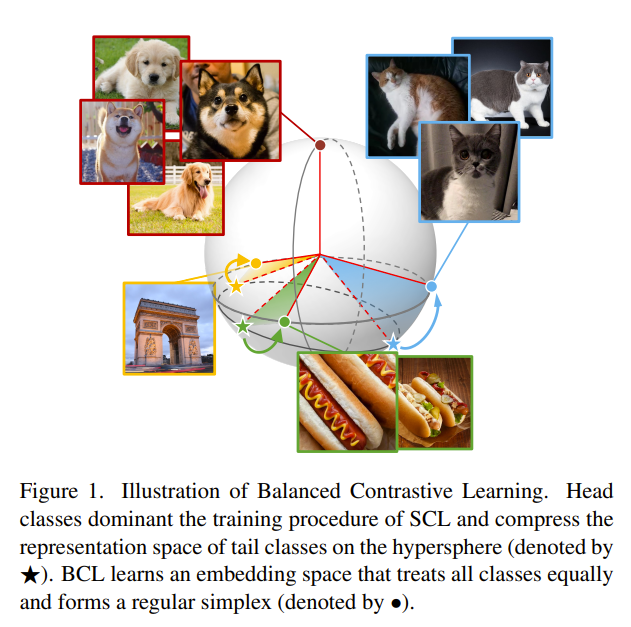
In this paper, the authors investigate the geomtric structure formed by representation vectors of classes and the class prototypes. They observed that past methods fail to form regular simplex geometries in the feature space, which is crucial for the generalization of the learned representations. A regular simplex geometry is has 3 crucial characteristics
- the mean of all class prototypes should be the origin of the representation space
- the class prototypes should be at a radius distance from the origin
- the class prototypes should be vectors of which the dot product with one another can be calculated
Problem Current approaches to long-tailed visual recognition (LTVR) fail to form regular simplex geometries in the feature space, which is crucial for the generalization of the learned representations.
Solution, Ideas and Why
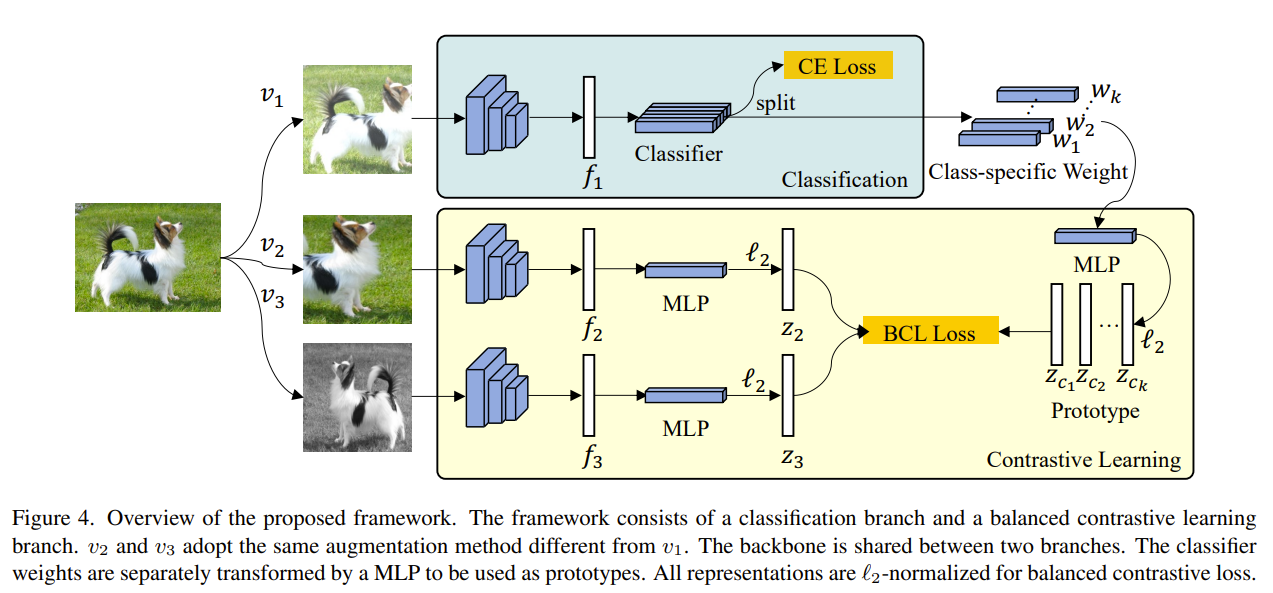
- balanced feature space has a regular simplex geometry
- class averaging reduces the effect head classes dominating the gradients in optimization
- class component introduces class prototypes in all minibatches so that all classes contribute to the optimization stably
- logit adjustment for classifier logits using the imbalanced class priors
- class prototypes are obtained from the MLP projection of the class specific weights of the linear classifier in the classification branch
-
Long-Tailed Recognition via Weight Balancing
BibTex
url= https://openaccess.thecvf.com/content/CVPR2022/papers/Alshammari_Long-Tailed_Recognition_via_Weight_Balancing_CVPR_2022_paper.pdf
@inproceedings{alshammari2022weightbal,
title={Long-tailed recognition via weight balancing},
author={Alshammari, Shaden and Wang, Yu-Xiong and Ramanan, Deva and Kong, Shu},
booktitle={Proceedings of the IEEE/CVF Conference on Computer Vision and Pattern Recognition},
year={2022}}
Summary
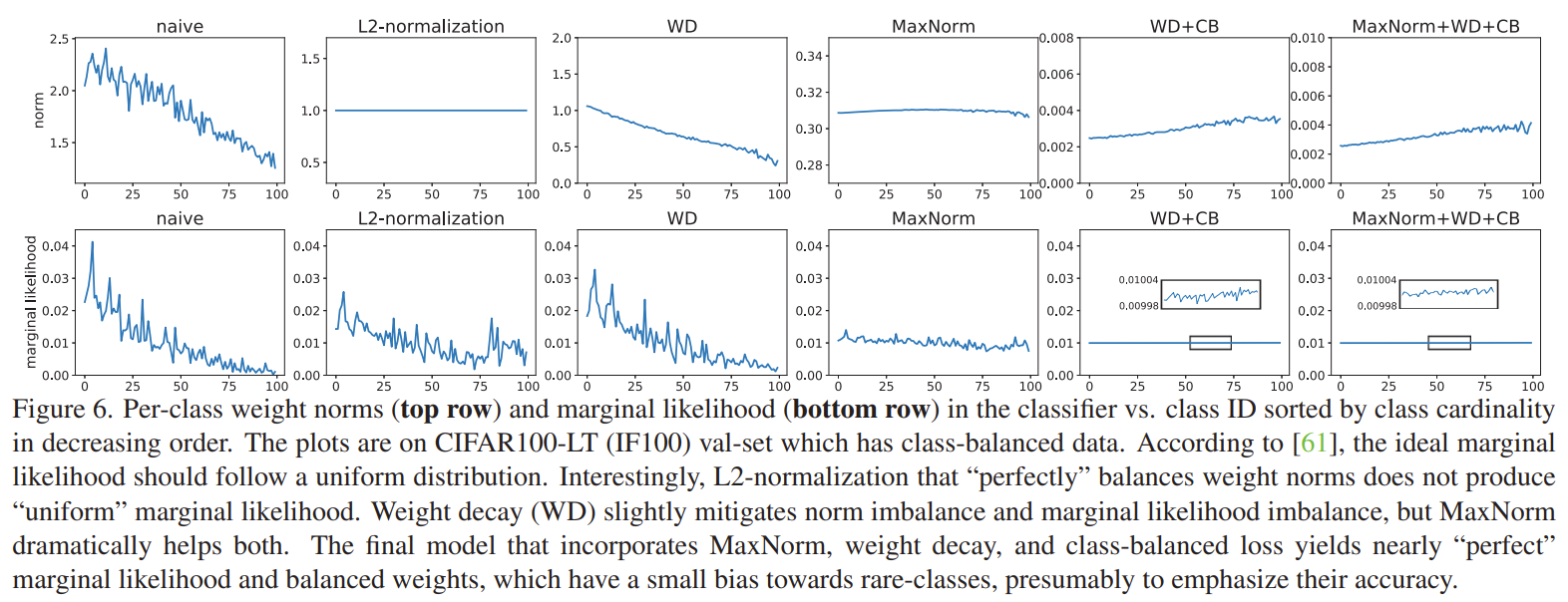
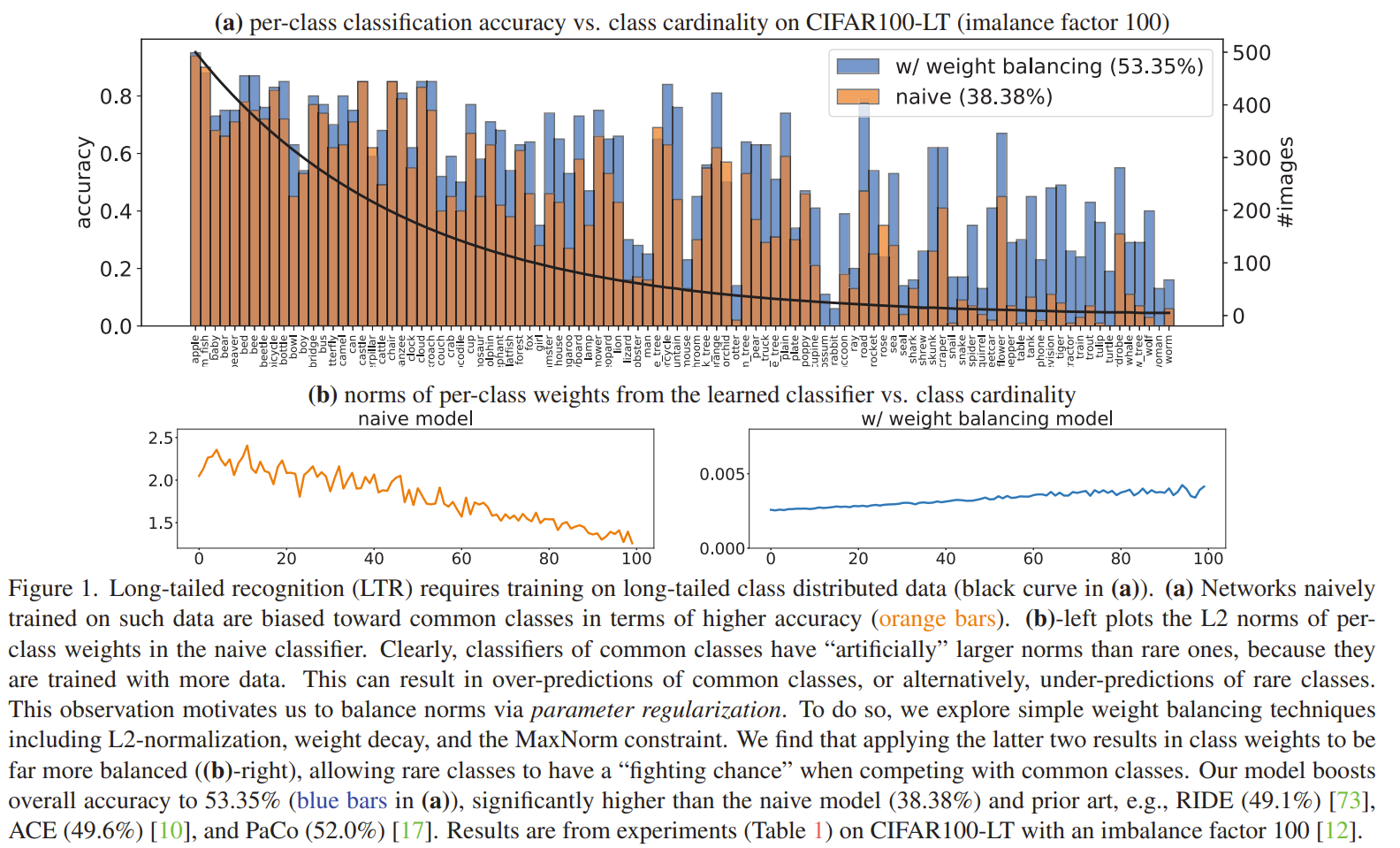
This paper is tackling the problem of imbalance classification. They observed that imbalanced data cause the norm of the weights to be larger for the head classes than the tail classes. This is because the head classes have more examples than the tail classes. Ideally the weights should be balanced so that the norm of the weights are the same for all classes. To tackle this issue, they propose a 2 stage training framework. In the first stage, they train the classifier with a weight decay term that penalizes the norm of the weights. In the first they use CE loss with a weight decay term. In the second stage, they train the classifier with weight decay and a maxnorm term that gives an upper bound to the weight norms. The maxnorm term is obtained by using the lagrangian multiplier to convert the original constrained optimization problem into an unconstrained optimization problem. The new object is a minmax objective when the original loss is minimized by the classifier weights and the maxnorm term is maximized by the KKT multiplier gamma. Intuitively, as gamma grows larger, the second term dominates the objective, forcing the learned weights to be less than the upper bound delta. to optimize both, the weights can be fixed to optimize gamma and then gamma can be fixed to optimize the weights. Combined wih class balanced sampling, the method achieves very uniform weight norms.
Problem imbalanced learned weights in the classifier
Solution, Ideas and Why apply weight decay in first stage as smaller weights are less imbalanced. using lagrangian, update the loss with a maxnorm term thatgive an upper bound to the weight norms for second stage.
Images
-
Nested Collaborative Learning for Long-Tailed Visual Recognition
BibTex
url= https://openaccess.thecvf.com/content/CVPR2022/papers/Li_Nested_Collaborative_Learning_for_Long-Tailed_Visual_Recognition_CVPR_2022_paper.pdf
@inproceedings{li2022ncl,
title={Nested collaborative learning for long-tailed visual recognition},
author={Li, Jun and Tan, Zichang and Wan, Jun and Lei, Zhen and Guo, Guodong},
booktitle={Proceedings of the IEEE/CVF Conference on Computer Vision and Pattern Recognition},
year={2022}}
Summary
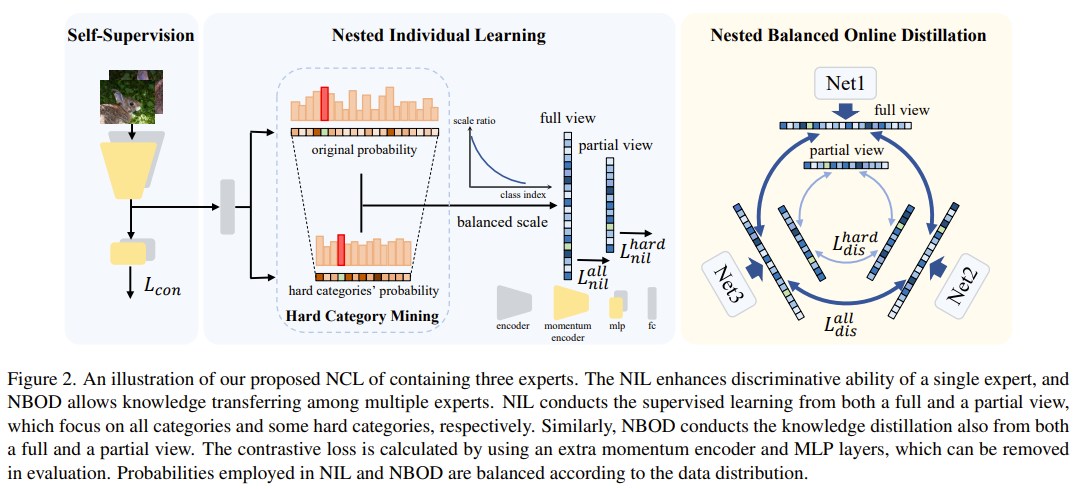
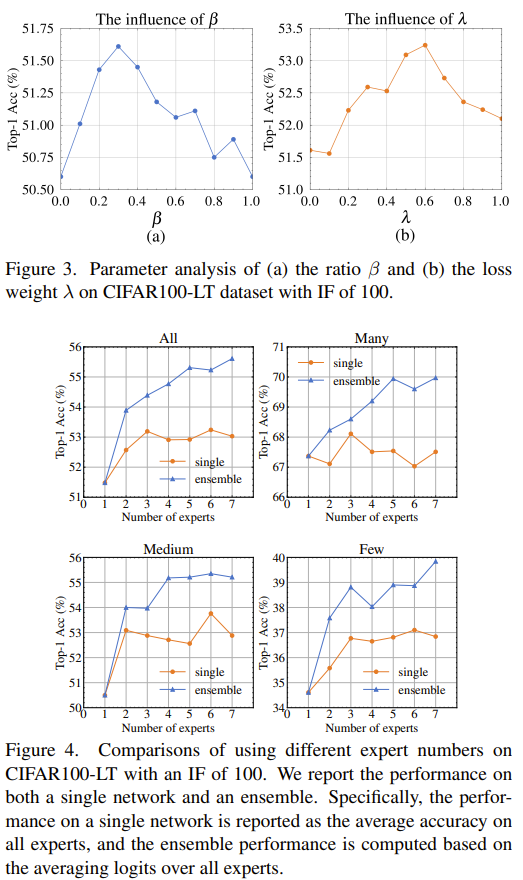
This paper tackle the issues of confident but incorrect predictions due to miscalibrated output logits by enlisting multiple experts. Each expert trains on a dataset with balanced softmax. In addition to the normal view of the dataset, they select a set of hard classes where a hard class is class that has the highest incorrect prediction. The hard classes training is also with balanced softmax and is nested within the normal training. Those hard classes allow to focus on learning feature that will help further discriminate them. The experts are trained to have similar posterior distribution but not too much. This is done by minimizing the KL divergence between the posterior distributions of the experts. However, if the expert are too similar, they are essential multiple instances of the same expert and the ensemble will not be diverse. To alleviate this, the keep the lambda parameter in the KL divergence loss to be .6. Also by encourage the experts to have the same posterior they are, in adhoc manner, encourage the expert to distill their knowledge to each other. Finally they add a supervised contrastive loss term to improve the feature learning. The final prediction is obtained by aggregation of the experts output.
Problem confident but incorrect predictions due to miscalibrated output logits
Solution, Ideas and Why training on hard classes nested within training on all classes. multiple experts trained to have similar posterior distribution but not too much
Images
-
Targeted Supervised Contrastive Learning for Long-Tailed Recognition
BibTex
url= https://openaccess.thecvf.com/content/CVPR2022/papers/Li_Targeted_Supervised_Contrastive_Learning_for_Long-Tailed_Recognition_CVPR_2022_paper.pdf
@inproceedings{li2022tsc,
title={Targeted supervised contrastive learning for long-tailed recognition},
author={Li, Tianhong and Cao, Peng and Yuan, Yuan and Fan, Lijie and Yang, Yuzhe and Feris, Rogerio S and Indyk, Piotr and Katabi, Dina},
booktitle={Proceedings of the IEEE/CVF Conference on Computer Vision and Pattern Recognition},
year={2022}}
Summary
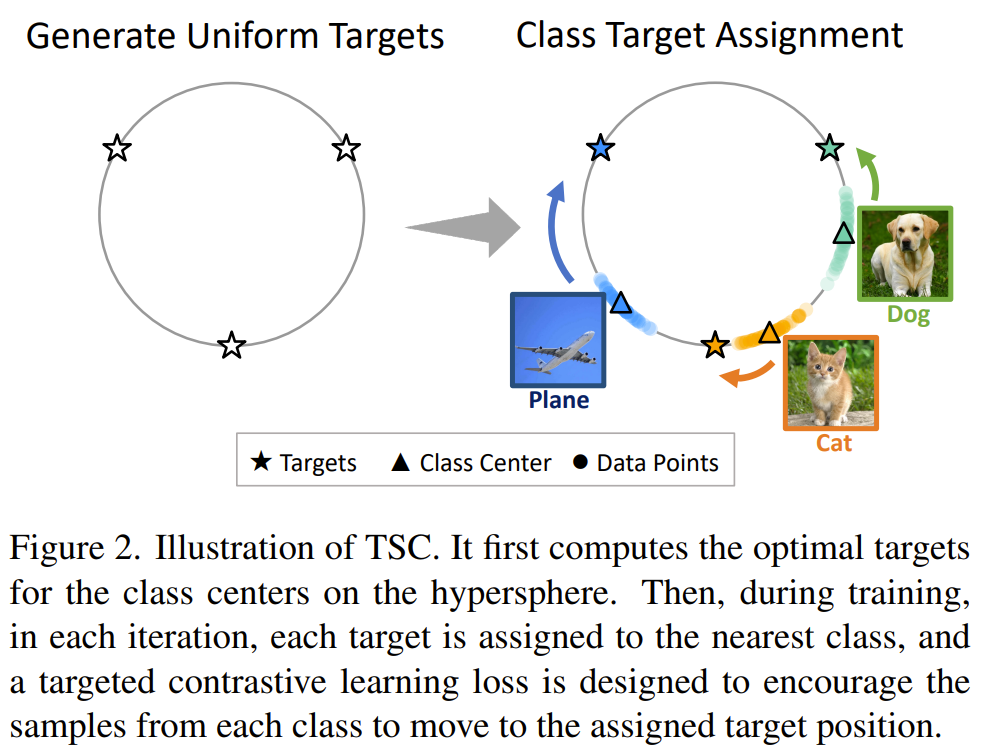
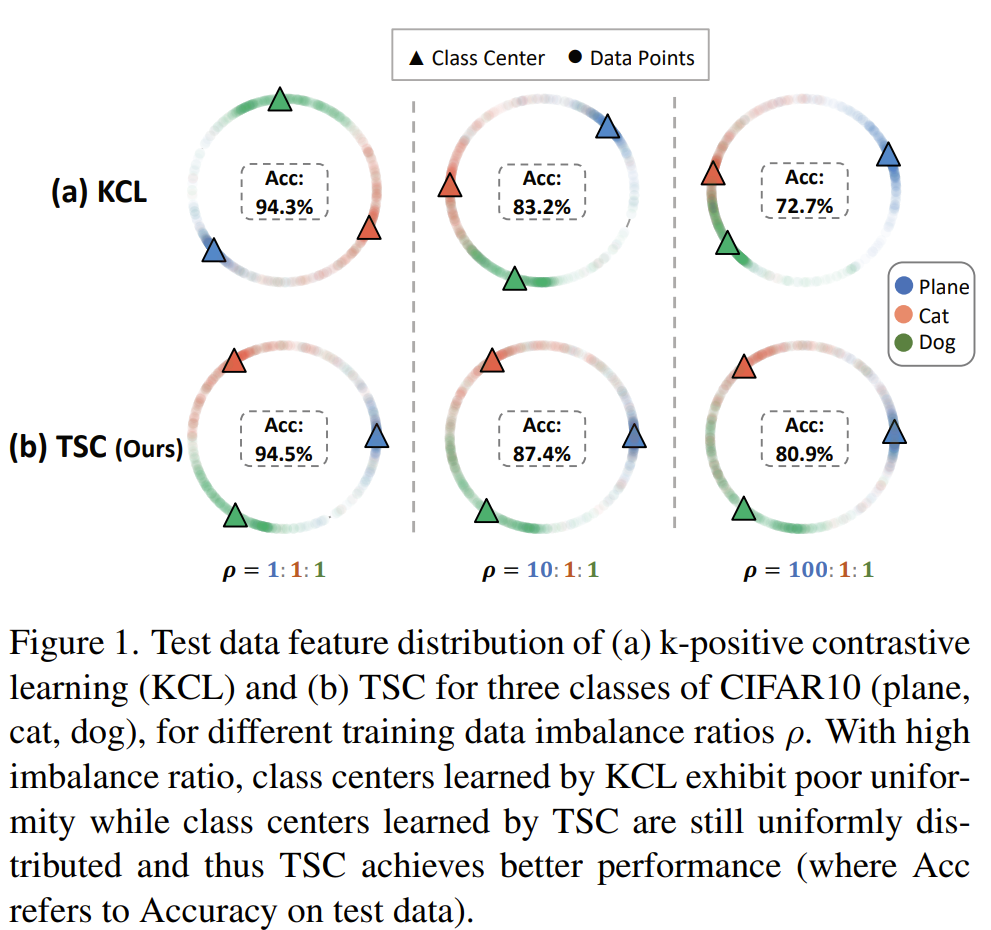
This paper tackles the issue of poor uniformity in the feature space brought in by imbalanced data distribution. Poor uniformity leads to poor separability in feature space. To solve this issue, they pre-process class targets to be uniform simplex geometry targets. They do this by generating uniform simplex geometry targets offline using stochastic gradient descent. Once the pre-computed targets are obtained, they assign each class to a target using hungarian algorithm such as to maintain semantic meaning of the proximity between classes. In other words, if two classes are assigned to be close together, their features should be semantically similar. The targets are then used in the supervised contrastive learning loss to encourage the network to produce representation that match the target assignments and produce a uniform simplex geometry in the feature space. To understand learned representations, they propose 3 metrics: 1. the intra class alignment that measures how close the features of the same class are to each other (lower is better). 2. the inter class uniformity that measures the average of the distance between between the centers of the classes (higher is better). However, the inter class uniformity is not a good metric because it is invariant to relative distance between neighboring classes and can therefore not measure if they class centers form a good simplex geometry. To alleviate this, they propose the 3rd metric, the neighborhood uniformity that measures the average distance between top k neighboring classes (higher is better). They also introduce reasonability as a metric to measure the semantic meaning of the proximity between classes using wordnet hierarchy.
Problem supervised contrastive learning baseline suffer from poor uniformity brought in by imbalanced data distribution. Poor uniformity leads to poor separability in feature space.
Solution, Ideas and Why
- generate uniform simplex geometry targets offline using stochastic gradient descent
- assign each class to a target using hungarian algorithm
-
Self-Supervised Aggregation of Diverse Experts for Test-Agnostic Long-Tailed Recognition
BibTex
url=https://openreview.net/pdf?id=m7CmxlpHTiu
@inproceedings{zhang2022sade,
title={Self-supervised aggregation of diverse experts for test-agnostic long-tailed recognition},
author={Zhang, Yifan and Hooi, Bryan and Hong, Lanqing and Feng, Jiashi},
journal={Advances in Neural Information Processing Systems},
year={2022}}
Summary
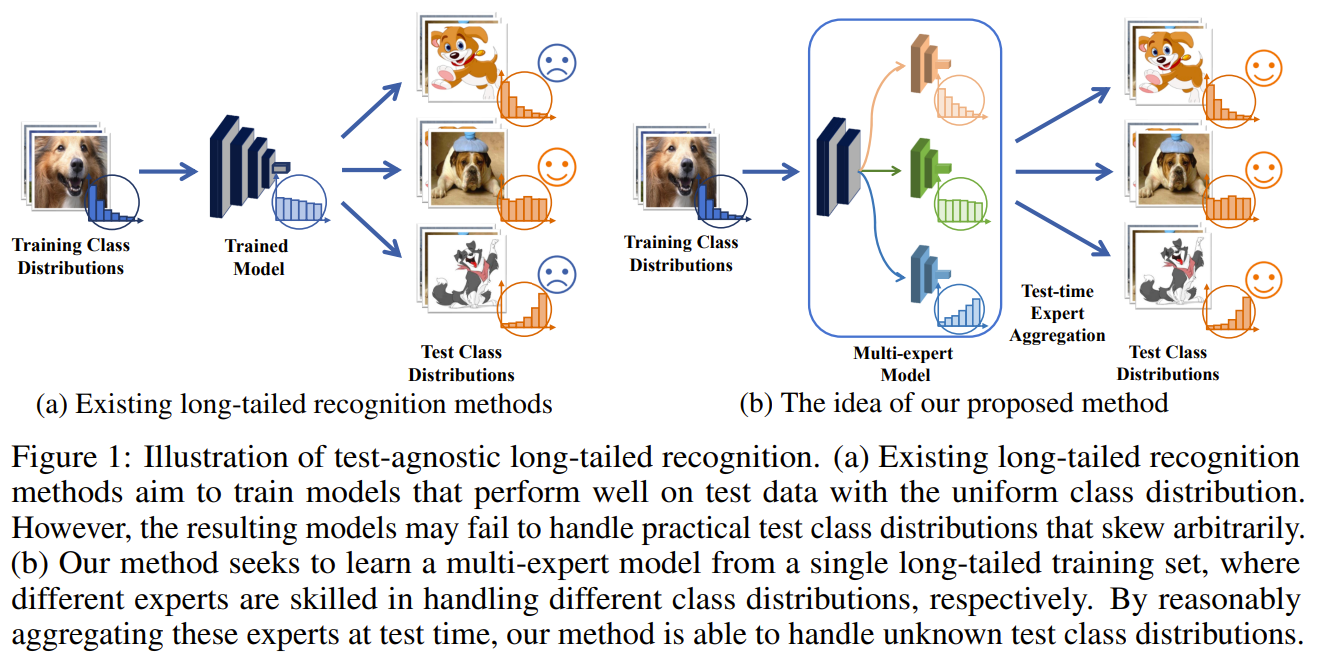
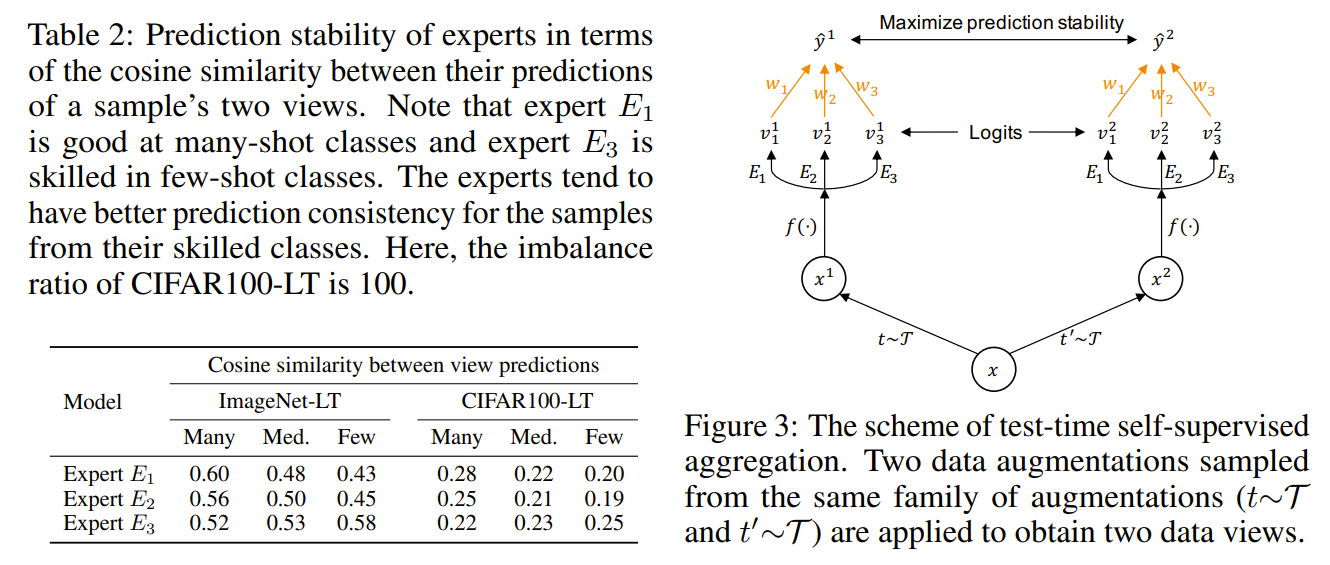
This paper tackles of imbalance classification. They observed that current methods are not test set distrubution agnostic. Assuming the test distribution is unknown, they propose a self-supervised method to learn a set of 3 experts that are trained on imbalanced, balanced, and reverse softmax loss. Each expert The forward expert trained on imbalanced (original) softmax loss with more focus on frequent classes, the uniform expert trained on balanced softmax loss with more focus on on middle classes, and the reverse expert trained on reverse softmax loss more focus on the rare classes. To intelligently aggregate the experts logits, they learn a linear aggregation function that combining the logits of each experts according to the learned weights associated with them. the aggregation function is learned by minimizing the prediction similarity between 2 augmented views of the same image passing through all the experts. This effectively leverages the stablity of the experts where the more stable the expert is, the more it is weighted in the aggregation. Their method is able to handle not just uniform distributions but also imbalanced and reverse distributions.
Problem unknown target distribution
Solution, Ideas and Why 3 experts trained on imbalanced, balanced, and reverse softmax loss. learned aggregation of expert prediction based on the prediction stability (truer expert are more stable in predictions)
Images
-
Self Supervision to Distillation for Long-Tailed Visual Recognition
BibTex
url= https://openaccess.thecvf.com/content/ICCV2021/papers/Li_Self_Supervision_to_Distillation_for_Long-Tailed_Visual_Recognition_ICCV_2021_paper.pdf
@inproceedings{li2021ssd,
title={Self supervision to distillation for long-tailed visual recognition},
author={Li, Tianhao and Wang, Limin and Wu, Gangshan},
booktitle={Proceedings of the IEEE/CVF international conference on computer vision},
year={2021}}
Summary
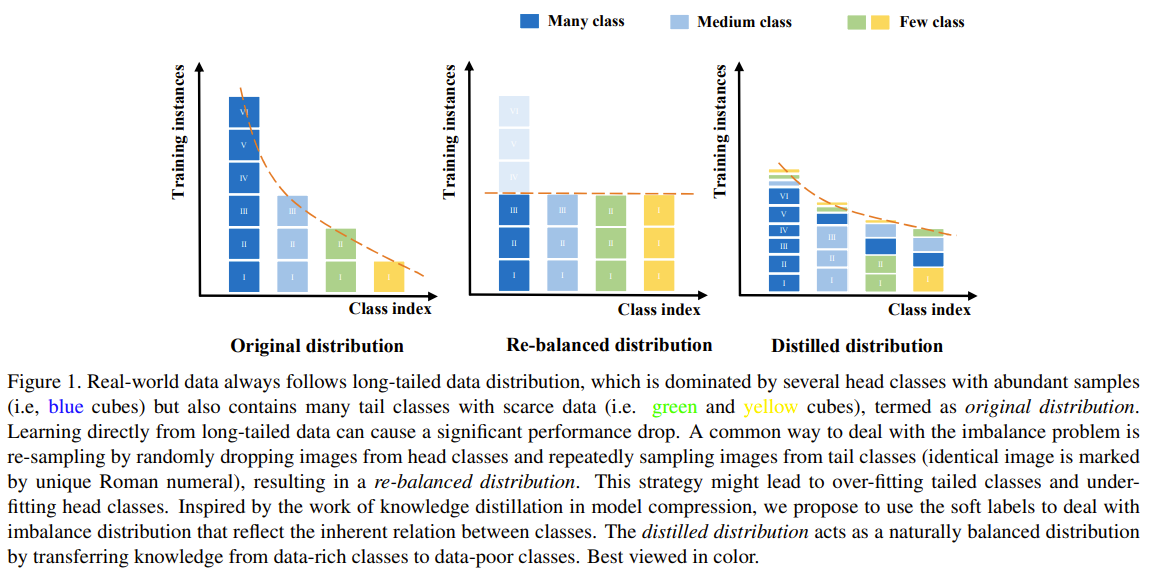
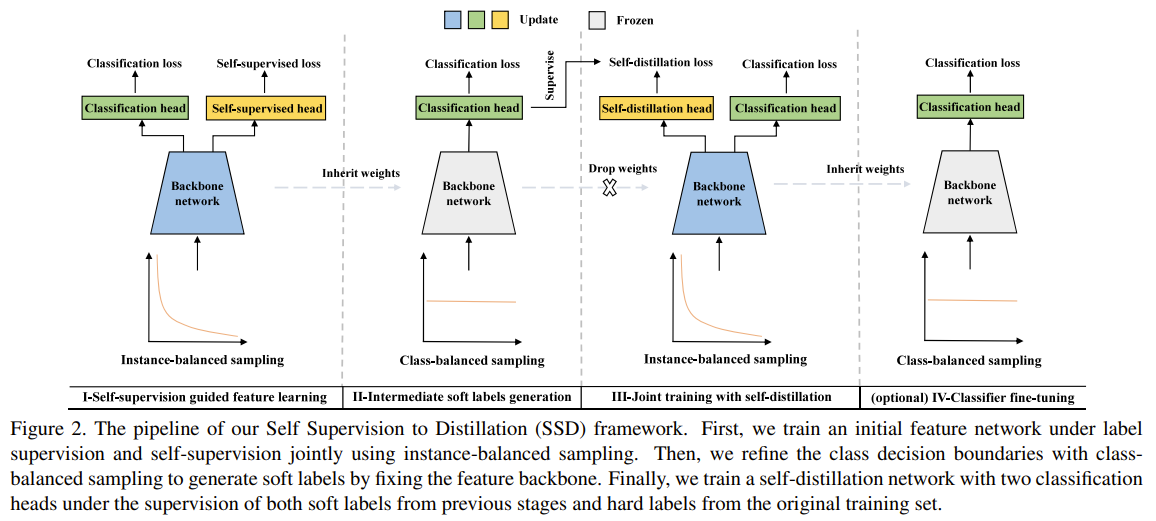
This paper tackles the issue of imbalance classification. The authors aimed at balancing the input distribution by using soft-labels. Soft-labels allows frequent classes to be boost the effective sample count of rare classes. They propose a multi stage training process. The first stage is learn a good feature extractor with a classification head and self-supervision head. The classification head learns to classify the input images into the classes under imbalanced sampling. The self-supervision head learns to predict the rotation of the input images and contrast an instance input from other instances. Once trained, the second stage uses the frozen weights of the feature extractor and trains a classifier head with balanced sampling. The learned network at this second stage is the teacher network, that will be used the produce soft labels on the dataset. Then the third stage is to train a student backbone with a classifier head that is trained on the hard labels and a self-distillation head that is trained on the soft-labels, both using imbalanced sampling. The classification head is used at the end for inference. Optionally the further train the classification head using class balanced sampling in a fourth stage.
Problem imbalance input distrubution
Solution, Ideas and Why use soft labels from teacher net to create a less imbalanced distilled distribution. retrain a student network with 2 classifier heads, one on hard labels and the other on soft labels
Images
-
Decoupled Training for Long-Tailed Classification with Stochastic Representations
BibTex
url=https://openreview.net/pdf?id=bcYZwYo-0t
@inproceedings{nam2023srepr,
title={Decoupled Training for Long-Tailed Classification With Stochastic Representations},
author={Nam, Giung and Jang, Sunguk and Lee, Juho},
journal={The Eleventh International Conference on Learning Representations},
year={2023}}
Summary
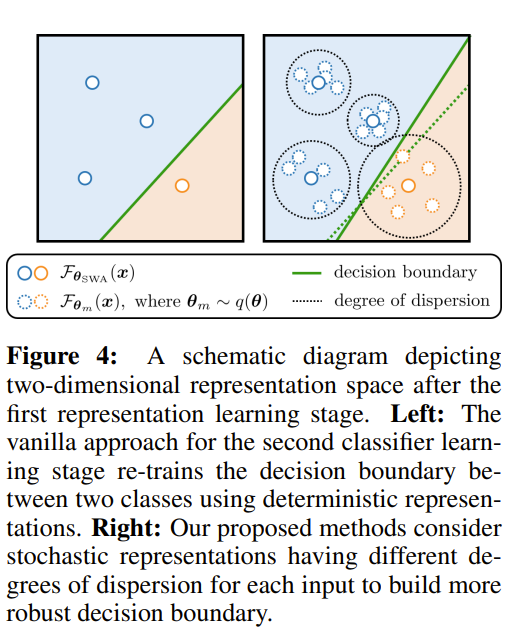
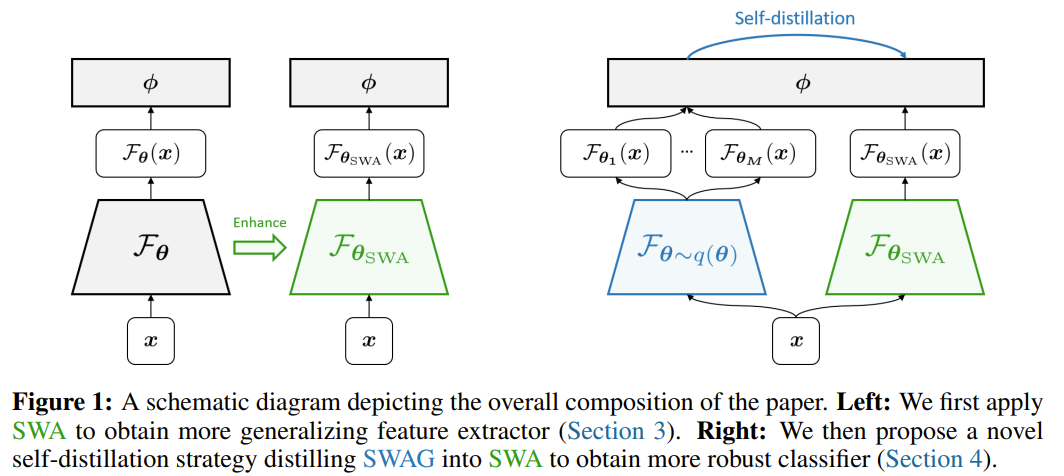
This paper is tackling the problem of imbalance classification. They observed that current methods have large uncertainty in the representations. They first observed that SWA or Stochastic Weight Averaging of the encoder weights ath the end of the training (last 25%) combined with retraining the classifier with the SWA weights resulted in improved performance compared to not using SWA. Furthermore they can obtain the mean and covariance of the encoder weights to build a gaussian distribution of the encoder weights estimating the posterior of the encoder weights (called SWAG or Stochastic Weight Averaging Gaussian). Using SWAG, they can sample M encoder weights from the gaussion distribution over the weights and use them as a stochastic ensemble to produce M representation of an input sample called stochastic representation. The stochastic representation capture the uncertainty in the representation space of the data. Using the classifier trained with the stochastic representation, they can produce M predictions for the input sample. The stochastic representation can be seen as dispersion of area of the representations in the feature space. A classifier trained on these stochastic representations will have better decision boundaries as it takes into account the uncertainty in the Representations. Once they complete the representation learning stage, they need to train the classifier. The naive option is to train the classifier that works on average with all the M representations. However, they would like to capture the uncertainty in the predictions, not the stochastic representations themselves. So, instead, they setup a distillation objective where the teachers are the M classifiers with their encoders and the student, initialized as the SWA classifier, is further trained to maximally absorb the diversity in the teachers predictions. Instead of directly distilling from the mean of the ensemble of prediction, they instead distill from the distribution of the predictions, so a distribution over the posterior distribution of the teachers predictions over the classes. After training, they can take the mean of the student dirichlet distribution as the final classification probability for the an input sample.
Problem uncertainty in representations
Solution, Ideas and Why CE stochastic representation via gaussian stochastic weight average. self distillation from M predictions to 1 prediction.
Images
-
Towards realistic long-tailed semi-supervised learning: Consistency is all you need
BibTex
url= https://openaccess.thecvf.com/content/CVPR2023/papers/Wei_Towards_Realistic_Long-Tailed_Semi-Supervised_Learning_Consistency_Is_All_You_Need_CVPR_2023_paper.pdf
@inproceedings{wei2023acr,
title={Towards realistic long-tailed semi-supervised learning: Consistency is all you need},
author={Wei, Tong and Gan, Kai},
booktitle={Proceedings of the IEEE/CVF Conference on Computer Vision and Pattern Recognition},
year={2023}}
Summary
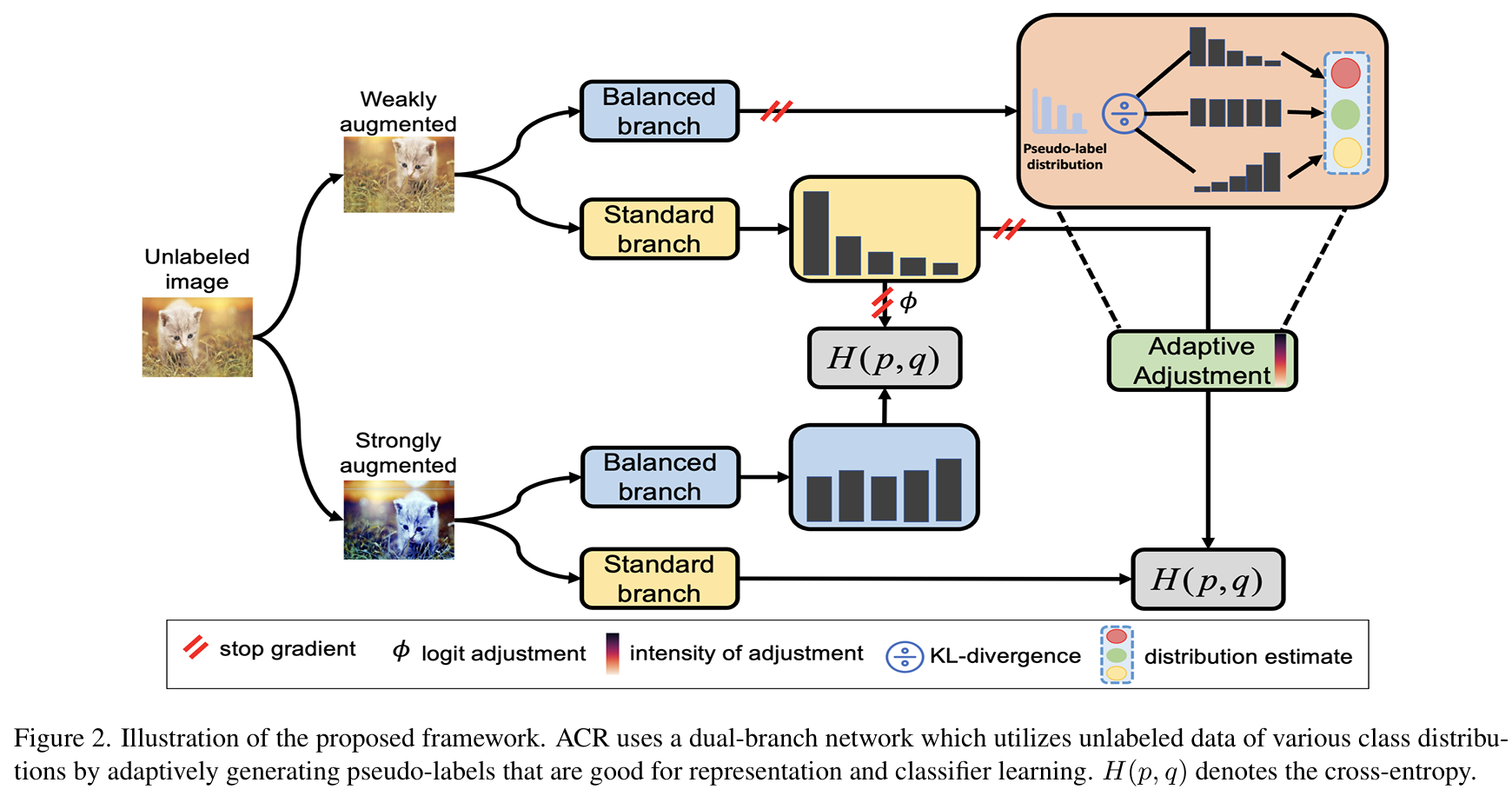
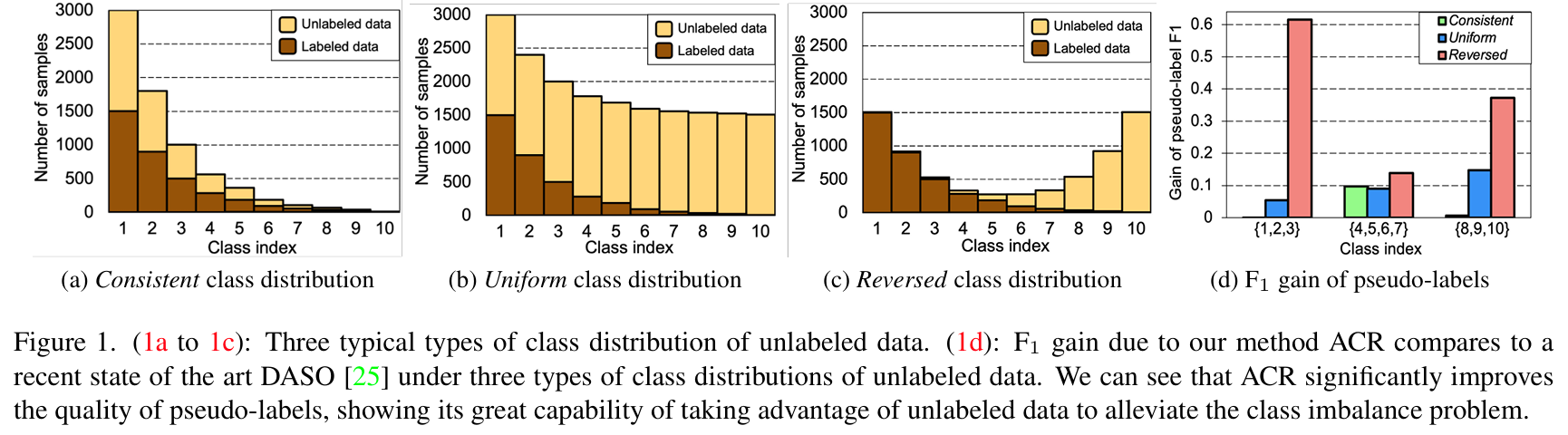
The paper proposes the Adaptive Consistency Regularizer (ACR), a novel approach to tackle the challenges of Long-Tailed Semi-Supervised Learning (LTSSL) when the class distributions of labeled and unlabeled data are mismatched. ACR extends the FixMatch algorithm by incorporating a two-branch network architecture to balance representation learning and unbiased classification. The network comprises a standard branch, which focuses on robust feature representation, and a balanced branch, which addresses class imbalance by leveraging adjusted logits and pseudo-labels. In the standard branch, the loss function includes two terms: a supervised classification term using standard cross-entropy for labeled data, and an unsupervised consistency regularization term that enforces prediction stability for augmented unlabeled samples using pseudo-labels. This branch primarily focuses on extracting strong feature representations by directly learning from the labeled and pseudo-labeled data without explicit adjustments for class imbalance. The balanced branch, in contrast, aims to counteract the inherent bias toward majority classes often seen in long-tailed datasets. Its loss function also has two components: a supervised term using a balanced softmax loss, which adjusts logits based on estimated class priors, and a consistency regularization term that uses refined pseudo-labels. These pseudo-labels are generated by adjusting logits to bias predictions toward minority classes, enhancing the balance in classifier learning. A key innovation in ACR is its pseudo-label refinement mechanism, which dynamically adjusts pseudo-labels based on the estimated true class distribution of the unlabeled data. To estimate this distribution, ACR compares the pseudo-label distribution with three anchor distributions—consistent, uniform, and reversed—using bidirectional KL divergence. The closest anchor distribution guides the adjustment of logits, ensuring the refined pseudo-labels align better with the actual class distribution. A dynamic scaling parameter (τ) is introduced to control the intensity of logit adjustments. This parameter is updated adaptively during training, based on the estimated distances to the anchor distributions. This flexibility allows ACR to handle diverse class distribution scenarios, such as consistent, uniform, or reversed distributions, ensuring that pseudo-labels are appropriately calibrated for both branches. Both branches share a feature extractor, fostering synergy between their objectives. The standard branch benefits from refined pseudo-labels for improved representation learning, while the balanced branch ensures fair and unbiased classification. Consistency regularization in both branches enforces robust learning, with each branch leveraging the refined pseudo-labels differently to optimize their respective goals.
Problem learning from long-tailed semi-supervised datasets with mismatched class distributions between labeled and unlabeled data
Solution, Ideas and Why pseudo-label refinement, dynamic distribution estimation, and consistency constraints.
Images
-
Transfer Knowledge from Head to Tail: Uncertainty Calibration under Long-tailed Distribution
BibTex
url= https://openaccess.thecvf.com/content/CVPR2023/papers/Chen_Transfer_Knowledge_From_Head_to_Tail_Uncertainty_Calibration_Under_Long-Tailed_CVPR_2023_paper.pdf
@inproceedings{chen2023unccalib,
title={Transfer knowledge from head to tail: Uncertainty calibration under long-tailed distribution},
author={Chen, Jiahao and Su, Bing},
booktitle={Proceedings of the IEEE/CVF conference on computer vision and pattern recognition},
year={2023}}
Summary
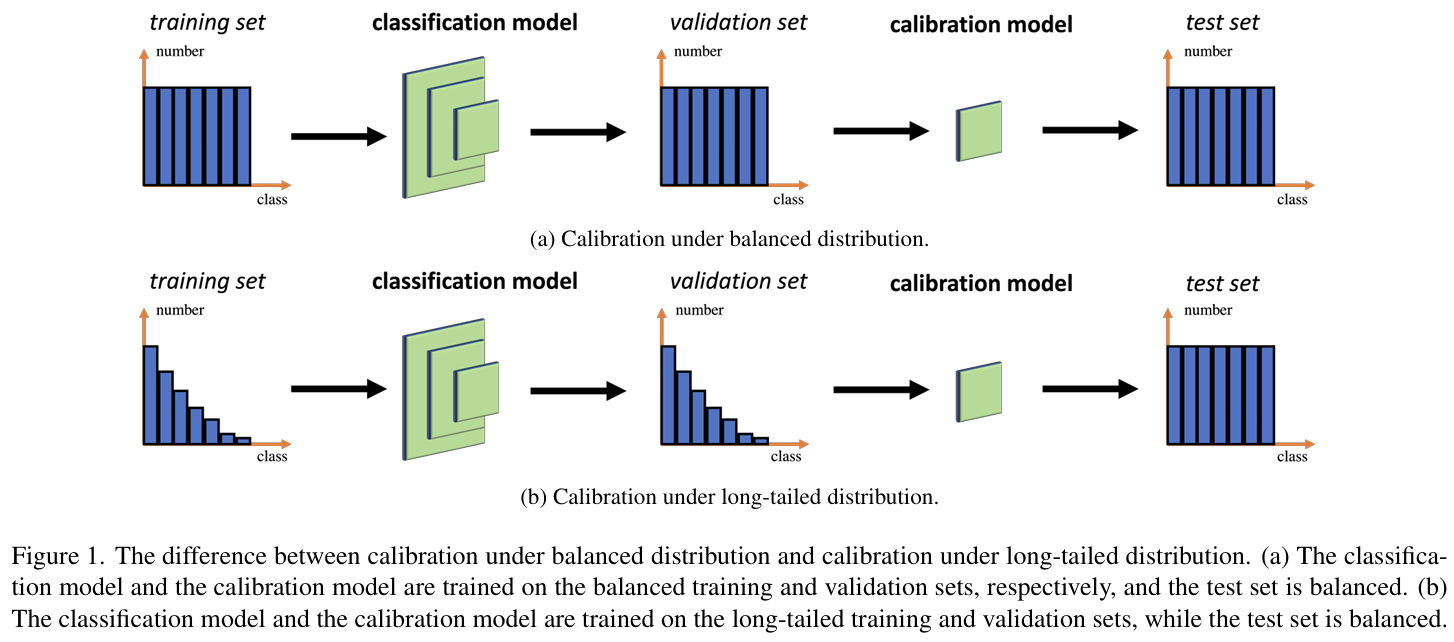
This paper tackles the challenge of uncertainty calibration for models trained on long-tailed distributions, where dominant "head" classes have abundant data, and underrepresented "tail" classes are prone to overconfidence and poor reliability. Traditional calibration methods, such as temperature scaling, fail to generalize well in these scenarios due to the mismatch between the long-tailed training data and the balanced test data. To address this, the authors propose a knowledge-transfer-based method that leverages the statistics of head classes to improve calibration for tail classes. The core idea is to model class distributions as Gaussians, with head classes treated as reliable estimates in both training and test sets. Tail class distributions, however, are estimated by borrowing information from head classes, guided by a similarity metric based on the Wasserstein distance, which captures both mean and variance statistics. The method involves constructing an attention mechanism to transfer information from head to tail classes. For each tail class, the similarity to head classes is computed using the Wasserstein distance, and this guides the borrowing process. The resulting estimated mean and variance for the tail class distributions are a weighted combination of their own statistics and those of the head classes. These estimated distributions are then used to calculate importance weights, which are defined as the ratio of the estimated balanced density to the observed long-tailed density for each instance. The importance weights reweight the loss function during calibration, allowing the model to generalize better across the mismatch between training and test distributions. Temperature scaling is applied on top of this process to further refine the calibration, with the importance weights ensuring the adjustment is tailored to the long-tailed setting. While the method is conceptually novel, its implementation introduces several significant issues. A key parameter, the borrowing coefficient (α), is set very high in practice, meaning the method relies minimally on transferred information from head classes. This undermines the fundamental premise of the approach, as the transfer of meaningful information is a central component. Furthermore, borrowing the mean from head classes is problematic, as the spatial position of the mean for tail classes in the feature space is unrelated to the means of head classes, leading to potentially misleading estimates. Borrowing the variance is somewhat more defensible, as it could reflect the uncertainty scale of tail classes. However, this approach risks inflating the manifold of tail classes excessively, causing overlaps with other classes and introducing classification errors. These limitations highlight a disconnect between the conceptual goals of the method and its practical execution.
Problem This paper addresses the challenge of calibrating uncertainty estimates for models trained on long-tailed distributions, proposing a novel method that transfers knowledge from head classes to improve calibration for tail classes using importance weights and Gaussian modeling.
Solution, Ideas and Why borrowing mean and variance from head classes to estimate tail classes.
Images